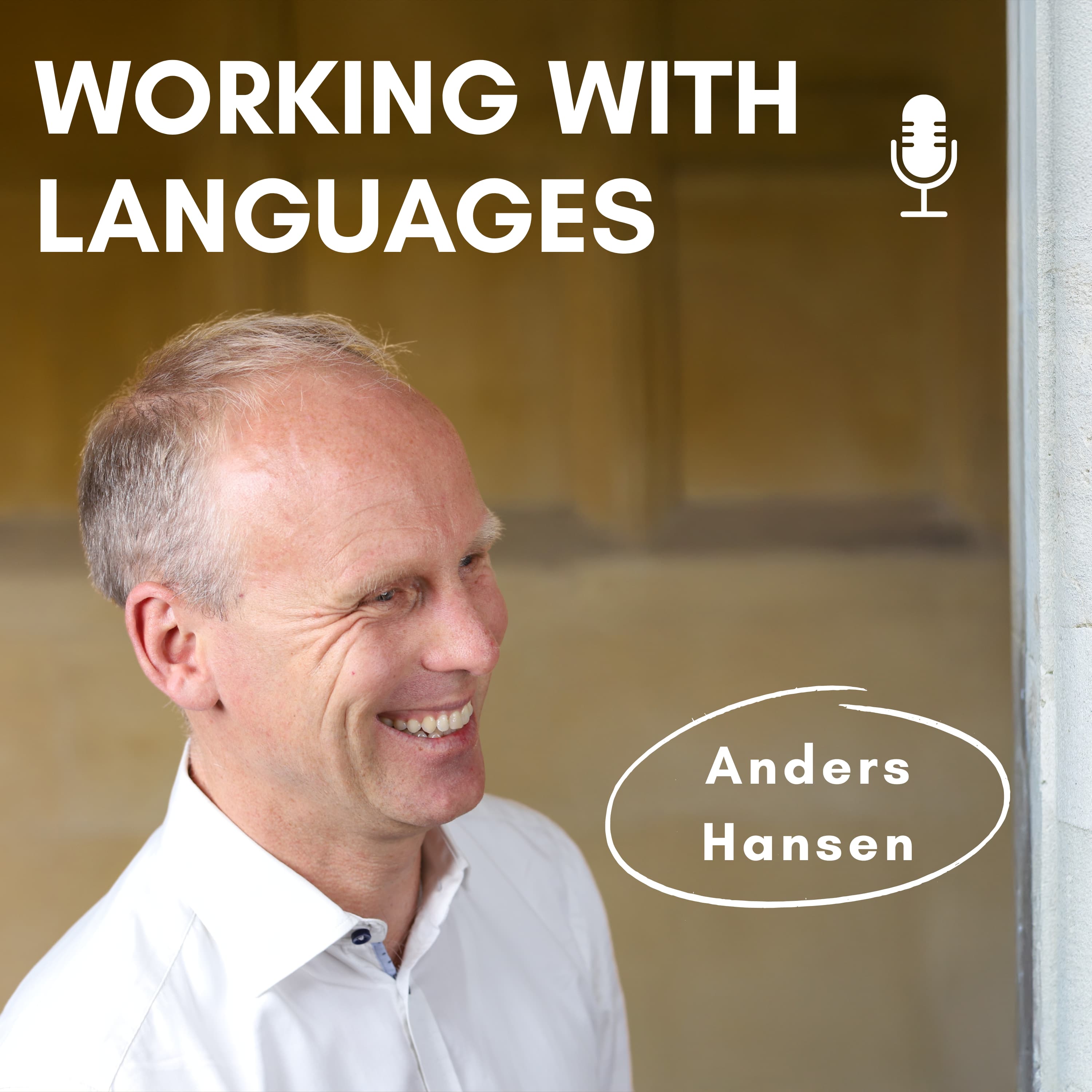
Sonia Kampshoff: Welcome to Working with Languages. My name is Sonia Kampshoff. I’m your host and a multilingual digital marketing consultant. My guest today is Anders Hanson, who lived in Denmark, Portugal, and England before he turned 18. After university, he embarked in a successful career in sales thanks to his language skills.
After spending 10 years in Asia, he moved back with his wife Caroline, first to the UKand now in Sardinia. It is a very honest conversation where he tells us about his successes. What he learned and his plans for the future. Let’s dive in.
Today’s guest on working with Languages is Anders Hansen. When I was preparing for this conversation, I realized I don’t have one single sentence or job title that can summarize and. Because his life has been so interesting and he’s had so many twists and turn and turns in his life. Let’s start from the beginning.
So Anders, can you tell us your favorite word or sentence in a language that you speak?
Anders Hansen: Yeah. Hi Sonia, and thank you for inviting me. It’s, um, it’s great to be here and I thought a bit about this great question of yours and I love languages. The one I landed on was the Italian expression ci mancherebbe altro. Why I’ve chosen this one is because one of the things I’ve learned since moving to Italy, Sardinia, is how polite people are, how courteous people are, which is something I really appreciate.
For example, they always say buongiorno, buon pomeriggio, buonasera, which I do so much, Caroline, my wife gets embarrassed about it, so. Is a way to respond when people say thank you, and they have many ways of responding when people say thank you, rather than just saying, you’re welcome. So that’s one reason I chose this also because it’s, it’s, it just sounds nice, but the second reason I chose it is because it’s impossible to translate.
There is no English version of this, but. So I thought that was fun, while the literal meaning of this short sentence is something else would be missing, the actual meaning is You’re welcome. Or of course, anytime.
Sonia Kampshoff: So tell us about yourself. You’re, you’re from Denmark, aren’t you?
Anders Hansen: I appreciate your introduction. It’s very flattering. However, it is also true that my life is a bit crazy. I, I basically, I’ve been very lucky. Some of that luck I’ve, I’ve made myself, but I was born in Denmark 51 years ago, but when I was nine years old in 1983, my family moved to the south of Portugal, the Algarve, where I went to an international school.
So from the age of nine, this international school we’re teaching German and French. And I’m, my parents moved us into a complete Portuguese countryside where I was lucky that we had Portuguese neighbors. So my parents tell me that like within three months I was fluent. ’cause I was just playing with these other boys in the area.
And that’s the way to learn a language. Young and full immersion. Yeah.
Sonia Kampshoff: Yeah. So you, you spent the rest of your childhood and teenage years in Portugal?
Anders Hansen: No, because the. International school only went to the age of 16 and there were no other opportunities for further study in the Algarve at that time. So someone recommended an English boarding school.
So I went and did my English A Levels and As levels in the south of England near East. Born, also in the middle of the countryside, which is where I’m very comfortable. And I spent two really wonderful years there where one of the major subjects I chose was French and I just loved it. I didn’t realize.
Yeah, as I said, I’ve, I’ve been really lucky and in the boarding school I made some very good German friends and French and Swiss friends, and one of the ways that I feel about language is if you’re gonna learn a language, it’s not enough to go to school. Or try and study it on your own. You need to immerse yourself, you need to throw yourself at it.
And having friends was a, a great way of, of practicing it. Absolutely. But, sorry, your original question was about my background in education. So after boarding school, I took a year off in Germany because I made some really good German friends in England and there were off to Cologne. And I thought, I knew by then that Germany was a, a serious place and I was keen to, to improve my German.
And I thought maybe I’ll go to university there. I can see by the look on your face. You didn’t know the, did you?
Sonia Kampshoff: No
Anders Hansen: I lived in, yeah.
Sonia Kampshoff: And I love how you say that Germany is a serious place.
Anders Hansen: Well, you know, I could go on for ages, but I’ve, I’ve said for many years that. Maybe some Danish people won’t appreciate this, but I think in many ways the Danes are, are like German wannabees, you know, the Germans that have this, this maybe, um, image of being, you know, very precise, very hardworking, very disciplined rule following, et cetera.
So I was very intrigued and I, I took a year off there. I’ll explain later why, why it didn’t really work out. So I took another year off in, in Portugal, which is where I felt at home. And then I went to university in London for my bachelor degree. Then in the meantime I’d met an Australian girl. So I was lucky with the danish welfare state was able to pay for me to study abroad for four years. So the fourth year I went to Sydney and did a master’s degree.
Sonia Kampshoff: Amazing.
Anders Hansen: I’m a big believer in this, not just because I benefited personally.
Sonia Kampshoff: And uh, so you went to Australia, then you did, uh, did you say you did your masters I, in the UK.
Anders Hansen: At university I did a joint major in media and cultural studies and philosophy. And they ended up tying in together very, very well. There was a lot of history, a lot of history of ideas. I followed more applied philosophies and a lot of politics. Um, history of England, uh, com post-Colonial England, and then the, the choice of doing international relations for my masters was, was at that point easy.
I, I’ve got a passion for, for this, the humanities, and I absolutely loved it. I said, if someone could pay for me, I’d go to university for the rest of my life. You like studying, you’d like learning and exploring things. Yeah. Yeah. Why not? You know, you get up in the morning, you go to the library, you have this amazing place where you can read about anything you want. Go and speak to like-minded people and, and share ideas. I loved it.
Sonia Kampshoff: And how long did you stay in Australia for?
Anders Hansen: Just that year because I was able to get a one year. Academic visa and then I had to leave. But at that point I was also ready. Actually. As much as I loved the university, I was ready to earn some money, not just emotionally.
I was also broke. The Danish state Welfare had finally run out. I’d used my student loan and I was keen to get a job. To stop working seriously. So I went back to London. I could afford about a couple of weeks, and then my mom, my dear mom was waiting in Denmark and looking forward to seeing me.
And, um, I never made it. Basically, I said, I think my career is best. It’s best if I stay in the uk. So I got the, the newspaper and I was trying to get a job to get back to Australia, which I fell in love with. It’s an amazing place. I saw this company, they were doing international conferences and they said, we are looking for salespeople.
And they said, if you hit your sales target, you can travel to any of our 40 offices worldwide within a year. And I’d kind of already seen by then that I had a salesperson in me. I was happy talking to people and, and trying to sell. So I applied. I applied for one job, and then I was invited to an interview.
I borrowed my friend’s suit, which was way too big for me. I went to this interview and I got the job and I was like, whoa. You know, this is a miracle. But it turns out in telesales, they’ll give anyone the job because it’s really tough.
Sonia Kampshoff: Is that how you learned, um, how to be a salesman?
Anders Hansen: Absolutely. Great question. Yeah. So there is no better sales training ground for than, than telesales because it’s cold calling and they had strict procedures. It’s 110 calls a day. You’ve gotta reach 10 decision makers that should close you. One deal every two days to hit your sales target super high. That’s a lot like, like a boiler room.
It was crazy. We were in the basement of this, uh, office near Oxford Circus and we had to come in wearing a suit and a tie, and I said to the director, I said. We are on telephone sales, we’re in a basement. Why do I have to wear suit and the tie? And then later I learned that that suit and the tie made you feel different, made you think different, you know?
And we were all young people, so, so psychologically that was an important thing. But key was that I learned how to sell. I picked it up and, and one of the things where straightaway languages came in. Because by then I was quite confident in French, German, Portuguese, English, and Danish. I could pretty much call anyone from Norway down to Portugal.
I could call most of Europe and no one else in the office could do that. So I, I was building up networks in Deutsche Bank, Leone, Big Swiss, you know, great financial institutions where my colleagues couldn’t get in because they didn’t speak the language. So it really, really helped me there early on. And this came as a surprise to me. That’s what I say today. I’ll say, and I may say this more than once today. Sorry. Languages, open doors. I totally agree.
Sonia Kampshoff: So were you the only international person then in that sales job?
Anders Hansen: It was mostly English, where I had a French colleague. He did very well as well. Jerry. I had a couple of Italian colleagues. A Swedish guy at some point. Yeah. But mostly in the office in London. It was, um. It was English. So then I hit my sales target. Within that year, the company actually delivered. And um, they said, is your passport in order? And they said, you can go to Sydney now as you’ve requested from day one. They said, but on the way, could you help us?
’cause we’re just opening an office in Singapore. Could you hang out there for a few weeks and help us, uh, get that office off the ground? And I said, yeah, sure. And they said, you can, you can, you can invite your girlfriend to come and stay with you. So suddenly, a few weeks later, January. 2000 I landed in Singapore.
Sonia Kampshoff: And how long did you stay in Singapore?
Anders Hansen: Well, it, it all took off then, you know, the whole effort was trying to get to Australia because I, I fell in love with Australia and I had a girlfriend there. But after one year in Singapore, we broke up. By then, my, my, my career there had really taken off. I started off in London. I was just on, on my own selling in Singapore. I started off like that and then I started managing it, managing a team, and then they asked me to build up five sales team sales teams. I became sales director and within two years they suddenly said, look, uh, we need a new general manager in Shanghai. Are you interested?
I mean, I was 28 at the time. This was crazy. So in, in January, 2002, I landed in Shanghai and took over an office with 60 Chinese staff. From production marketing, see HR 40 salespeople, which is where I was at home and my career really took off very fast with this company. A great training ground. So when you landed to, uh, when you landed in China, were there only Chinese people or were there.
Sonia Kampshoff: was there an international team already in place? How did you fit in? How did you communicate? Was it all in English, you know, was there, was there also a culture shock, I guess?
Anders Hansen: Yeah. All all good questions. Yeah, of course. So Singapore they say, is, is Asia light? Because in Singapore everyone speaks English. And everyone follows the rules and you are safe. And it’s very nice. It’s, Singapore is fantastic. For me as a Danish person, it was too hot. It was like 40 degrees every day, all year round. I, I, you know, so after two years I was really ready to move on. Then you land in Shanghai. This was 2002 and no one spoke English and the office I took over was. Was wrong in so many ways.
You know, people there, they, they really took the law into their own hands in many ways. There was one time where we, we ran a conference, actually it was a professional training call, so we’d get an international trainer to come and talk about something relevant to the market, and then sell sponsorship and the delegates to come and attend this training.
One time the trainer we got had to pull out five days before, so we had to make a decision. Do we replace the trainer or do we postpone the event? And my producer had said, oh, I’ve got another trainer. But then they weren’t happy with the trainer. So at midday, on the first day, they, they all, the delegates came from, we always held them at five star hotels.
Suddenly all the delegates showed up on the doorstep of the office wanting to talk to me, the general manager. They wanted their money back. Money. And then the owner of the company in London had a policy never, they never gave back the money. That was a bit scary. It was, uh,
Sonia Kampshoff: I can only imagine how tricky that situation must have been.
Anders Hansen: Yeah. That’s for another podcast.
Sonia Kampshoff: What happened next? But, so yeah, so, so China was, I would say, the closest. I’ve come to a culture shock, but coming back to, to today’s podcast, working in languages. Whereas in Europe, I was really comfortable and did really well because I spoke so many European languages.
Suddenly I was in China, and how did I get by? Well, funnily enough, I ended up joining a Danish soccer team, football team. Shanghai Vikings and so I never spoke.
Sonia Kampshoff: That is, that is still in China, right?
Anders Hansen: Yes. This is still Shanghai. Yeah. ’cause I spent 10 years there, but I found this, this football team and whereas work life work was, was very tough suddenly to have this group of friends, to have this football team you could go and hang out with and do some sport with and really was a, a great group of friends that I think kept me sane to a large degree.
But then, you know, I’d never spoken as much Danish as when I moved to China, which was quite crazy when you think about it. And the mistake I made was not dedicating myself to learning Mandarin. I, I didn’t learn the language. I got the staff in the office, had to speak English. So that was a negative, that was a disadvantage for the business, that I could only hire English speakers, otherwise I couldn’t talk to them.
And after a few years in China, so then I was contact, I tried to do my own business in China. Helping French and Danish companies export. So I had a French partner who would source the products and then I would travel to Denmark and France to try and sell our services, helping people export from China.
I pulled out of that after two years, and then I was approached by Danish companies who wanted their own person in China to look after their interest. Business interest in China. So I ended up managing a business that was selling fashion jewellery for, I worked for them for almost five years now. Had you asked me beforehand, would I have chosen to go into fashion jewellery? Look at me, no. Would be the answer.
However, when I met the founders of this company, they were just the most incredible people. They were absolute artists and creative people that had built this company from scratch, and I learned so much about design and their passion was just. So I really, really enjoyed working from them and, and trying to make, to, to make that business take off in China.
Then I was approached by another company, but trying to manage a business in China when you don’t speak the language, you know. Was was, was silly, was it wasn’t right. I didn’t feel good and I sat in Shanghai looking back at Europe and when you’re sitting in Shanghai in China and you look at Europe and you see so many little countries, you know, each with their own cultures and, and habits and and norms and food and languages, you realize what a disadvantage and advantages that is for Europe.
Whereas in, in China, everyone pretty much speaks Mandarin. But I just looked at myself and I said, um, it’s a waste. I’m sitting here in China. I can’t really be who I am and and use my skills as a salesperson and and manager because I don’t speak the language. And then after a few years of in China, I met my wife and she was the opposite.
She’s very clever. She had learned and studied Chinese, so she was awesome. And when she met me and she saw that I was useless, she said, you have to start learning Chinese. And I made an effort. But honestly, I found it too hard. Mandarin. Did she find a way of learning Mandarin That was easy. A good, good question.
So she was very goal-oriented. She took, after finishing, she’s from Cape Town, so after finishing university there, she took two years off in Parvan, north Italy and learned Italian. And already then she knew she was going to China, and you must have asked her where that idea came from. Um, so already in Palava she started to learn Chinese and as well as learning Italian, and then she moved to the Chinese countryside to teach English where nobody spoke English.
So, so she moved into the countryside where, where no one spoke English. She immersed herself, kept studying whilst making a living by teaching English. So by the time she reads Shanghai. Chinese Mandarin was awesome. It’s very clever to force yourself into a situation where you, you really have to learn a language.
Yeah. Yeah. Um, and that’s, you know, if, if you do that for a few months, maybe even a few years, that really is, you know, you, you can see the results and you, you get the fruits of your labor and you speak the language well.
Sonia Kampshoff: So by the time you met, uh, her she was, um, fluent, would you say?
Anders Hansen: Say, and for me. Although my career was, I was doing well, I had good jobs, I looked around me and I saw young Danish, French Germans arriving in Shanghai who had learned Mandarin beforehand or they got there and they applied themselves to learning it. And within a year or so, they would go out and they could pretty much get any job they wanted because they spoke Mandarin.
And I just, I felt so useless. I felt like I, I, I felt disrespectful because I saw my friends and having relationships, friendships with Chinese people that I couldn’t have because I hadn’t learned the language and I just felt this is a lack of respect. I’m in their country, I’m a guest. And I haven’t even made the effort to learn their language.
So that’s when I had to make the decision that, that I had to leave China because I realized that I wasn’t gonna learn Mandarin. And it’s actually very honest of you to, you know, to acknowledge that you made a mistake, that you were a guest in that country, and in hindsight that you should have learned the language.
Yeah. That took some time. Okay. Before that, it’s just, I mean, like most places there were massive groups of expats. You know, a lot of my, my Danish friends, they just hung out with each other and they never learned Chinese either. So, and you see this all over the world. I saw this in Portugal. I see this here in Italy.
That’s na, that’s natural. But for me, I reached the point where I said, this is not right. China is an amazing place with, with wonderful people, and there’s so much variety within China because it’s so massive and the history is amazing. But I can’t make the most of it because I, I can’t. Caroline, she would, before she met me, she would, she traveled all over China on her own and, and really experienced it and, and appreciated it.
And I couldn’t do that. And, and you can say, I didn’t find the time. I would say I didn’t prioritize it. You know, if you’re gonna learn a language, you need to dedicate yourself to it. You need to invest in it, and it takes time. So after China in 2012, we decided to move to London, and we’ll talk about that in a minute.
After that, we decided to move to Italy, and at that point I knew from my China experience that I’m not gonna make the mistake again. So already early on I started learning Italian. I started studying Italian. So tell us about your time in London. So another thing that hit me as I reached Shanghai after a few years in Shanghai was like, how did I end up in Shanghai?
I was trying to go to Australia, you know? But as I said, I, I do know that I’ve been very lucky, but when we decided to leave Shanghai, rather than changing country and career because of a job offer. This was our own decision. This was our own initiative, and I realized I had to, to, to quit the job I was doing there and move to England and start a new job, a new career.
So it was a blank slate. It was a new page. I spent a lot of months actually considering and thinking about and talking to people and researching what should I do. I realized I knew by then I was approaching 40 years of age. So I realized by then that what were my strengths were communication. Sales and management.
And then I decided for other reasons, many reasons, to go into software sales. So I arrived in London October, 2012, and I started contacting headhunters, started applying directly to jobs, and everyone I spoke to told me, you haven’t lived in the UK since 1999, right? That’s 13 years earlier. And yes, you’ve got a good sales experience and management experience, but you don’t have any experience with software.
So this is gonna be tough. So, so you were, you were set in finding a job in software sales. Why? Why software? Because. I used a lot of software. I enjoyed software. I could see how software more and more was coming into work. Look, I’m so old. When I started doing sales, I was sending faxes for my information, right?
So I saw email arrive and you know this like video conference calls. Is crazy tech, right? This didn’t exist when I started, so I kind of realized that, hey, there must be a pretty good market for this. And then I heard other people in software sales saying this is the place to be. And I already also realized that.
As much as I’d enjoyed working for the fashion jewellery company, it wasn’t what I was gonna choose to do. So yeah, it was very deliberate, a very serious choice to go after software sales. That was very difficult, right? They said to me, you don’t have, uh, you don’t have experience in software sales. But I, I kept at it, and that was October by April the next year, so got seven months later I got a call from a headhunter saying There is a company, they do customer service software and they’re expanding and they want someone responsible for the Nordics.
So once again, I was asked to join a company because of my languages. That’s amazing. So you combined really your sales experience, even though not in the industry and your languages. Once again, the languages were a real strength.
Now to anyone considering going into tech, I would say. I sold tech from London for 10 years and I loved it and I did very well from it. But tech sales is, is very tough, but technology is evolving so fast that companies need to adopt it to stay competitive. Therefore, there is such a demand for people in the tech sector.
I think there’s gonna continue to be, so for the foreseeable future, of course, I can’t tell you what’s gonna happen, how AI is gonna affect this. We can talk about that a bit later. But you can go into customer support, customer success, marketing solutions, consultants. I mean, I worked with so many wonderful people all over those years from, and the beauty of this company was, uh. They hired people from all over the world. So Zendesk, which is a company I worked for, was beautifully multicultural.
Sonia Kampshoff: Why would you say that it’s more difficult to sell software compared to other products, um, fashion jewellery like you were be, uh, selling before. Why? What, what’s the difference?
Anders Hansen: Well, I’m sorry, I didn’t mean to say that difficult. Another part of your question, the difference between fashion, jewellery, and software or conferences is that one is a, is a physical object, a piece of jewellery. The other is software. So with, with a software sale and a like a conference, when you are selling it, you’ve got to paint a picture in the mind of the person listening about what is this service gonna bring you? What’s the value that this is gonna bring you in the future?
Whereas when you are selling a bicycle or a table or chairs or, um. A necklace, it’s a physical object that where it’s a very different conversation, so you sell it also to an individual person and probably the price point is different as well.
So as opposed to the software where there’s many more, um, uh, stakeholders, decision makers, it’s probably more of a long-term decision for the company whether to adopt it or not. And probably it’s more expensive too. Yeah, that’s another key difference. So with the, with the fashion jewellery in Shanghai, I was selling both wholesale to other retailers and distributors.
Mm-hmm. But I also, in order to get close to the business, we opened up three retail shops ourselves in Shanghai and, and Suho right next to Shanghai. So I was doing selling to private individuals, but I was also selling to business and the software sales and the conference sales in Shanghai was all B2B.
So it’s business to business. And then, yes, this is very different from selling B2C to selling to a private individual. And yes, as you say, when you’re selling B2B, there can be many stakeholders depending on what kind of company you’re talking to and, and what is the price point of, of what you’re selling. Sure. So in the end, you worked for 10 years with, um, this technology company.
Sonia Kampshoff: And how would you say your experience was in technology? 10 years is quite a long time. Did you see any changes while you were there? And any expansion? What can you tell us?
Anders Hansen: Uh, when I joined the company, there was about 250 staff a year after I joined they IPOed in New York.
Sonia Kampshoff: Gosh.
Anders Hansen: Yeah, that’s a big change. Eight years later, we were about 4,000 staff globally when I left. And when I started I got all of Scandinavia. So I had from Finland to Denmark, but within half a year they hired an awesome Swedish lady who got Finland and Sweden. So then we divided it, and then as time went on, they kept adding people and dividing, carving up the territory, and that was absolutely the right thing to do.
So you had to become more efficient, essentially, in a smaller geographical area to sell to? Yes. And that was also as, as the product evolved. In the beginning, the product was more adept to smaller companies. But as the, the service, the software grew more complex, it became interesting to larger companies. So then we also distinguished between the kind of company that we spoke to, and I was mostly focused on the small to medium sized businesses.
Sonia Kampshoff: So. I find it interesting. So, uh, Zendesk is a software for customer support. Hmm. Um, did companies before Zendesk, did other companies offer the same kind of software or how did Company provide customer support?
Anders Hansen: This is another podcast, Sonia. Ah. Well, funnily enough, um, as I was uh, battling with the tech of getting into Riverside at one point I was offered to go to the help page and I can see that. And just for the listener, Riverside is the software that you use to record this podcast and it’s a very good piece of software. And they are Zendesk client. I can see ’cause there are little telltales that I can recognize.
Sonia Kampshoff: Yeah, I find, I find that, I see Zendesk very often, you know, um, when I, when I use products or services, and I have a question, most of the times there’s Zendesk, they seem to be everywhere now.
Anders Hansen: Well, if you are seeing Zendesk, they’re not using the software properly. Sorry. But this happens often because the whole point of Zendesk is, it’s, I mean you can totally seamlessly customize it and brand it so that you don’t see it’s meant to be your brand. And. Your look, but the customer service is just, for example.
Sonia Kampshoff: How did it change?
Anders Hansen: Back in the old days, if you needed customer service, you would send a fax or send a mail, like snail mail or call them or walk to the office and knock on the door.
Sonia Kampshoff: How has software changed that?
Anders Hansen: Software has changed that because you can chat with them. You can do a voiceover IP call, you can go to their website, can click on a button. You know, there are so many different ways of getting in touch with a customer service person. Getting 24 hour service because the customer service teams can be located anywhere because they log into a computer and access the service in the cloud. That’s a very short answer.
Sonia Kampshoff: Yeah. Okay, so going back to your time at Zendesk, um, you, I, I had the impression that you were very happy there and successful, so why did you leave? Tell us about that.
Anders Hansen: So a, again, coming back to anyone thinking about going into tech and sales, as the company expands from 250 staff to 4,000 staff, there is an incredible change of management. Yes. And I had a lot of different man, I had a lot of different managers. I’ll come. Can I just tell a little anecdote from my time in Cologne, because I went to Cologne to try and learn German and the first job I got was offloading trains with boxes at 6:00 AM. I had to get up at 3.30 to get two to get to this platform, and one day I came one minute late and the director looked at me and said, Hansen wir fangen um 6 Uhr an!
Sonia Kampshoff: Which means we start at 6:00 AM.
Anders Hansen: Not, you know, cultural and the guys I worked with did not speak, not the kind of Deutsch I wanted to learn. And this was, you know, I got to Germany thinking I knew about life. Then I got a job in a cafe closer to where I stayed. The problem was there, the manager was Italian, and the guy behind the bar was Portuguese.
So I’d go to work and hang out with this Portuguese. Now he taught me everything about how to run a guitar, how to make coffee, and he was awesome. But I didn’t really learn. German, and then why I’m jumping back into this is because that owner of that cafe was a terrible manager. He was like a tyrant. And that was my first experience of poor management and I just had to go because , people leave because of good men, because of bad managers, and people stay because of good managers. And in my time at Zendesk I saw both. And in the end I was in a position where I just didn’t agree with the people managing me. And then you have to leave. Okay. And that coincided with your move to Sardinia.
I took, uh, a year at one other Silicon Valley. Tech startup and same thing. I went in, I had a, this amazing manager in Paris and we got along like a house on fire. He trusted me. He, he let me do my thing. I built up a sales team for Germany and the Nordics, but then suddenly San Francisco decided to change the management structure completely.
And people with little or no experience in Europe came in and started telling us how we should run the business. So. Again, there, I had to say I don’t agree with this way of, of managing the, the business, so I have to leave unfortunately. And then, but then at that point already Caroline and I had said, it’s time to move to to Sardinia. And, and by then we had found this house, so I was kind of ready to go anyway.
Sonia Kampshoff: Why was it Sardinia? Was it, uh, I think Caroline always wanted to move back to Italy, but why Sardinia in particular?
Anders Hansen: Now, while she’d taken those two years off in Padova before China, she had, um ended up on a holiday in Sardinia and she’d fallen in love. So she had come back here with friends and family, and from the moment I met her 20 years ago, she had talked about Sardinia. So when we moved to London, she could finally bring me here and immediately reminded me of where I’d grown up in the Algarve.
The climate, the sea, the sky, the people, the food, the lifestyle. So I fell in love immediately as well. Sounds, uh, so beautiful. I mean, I’m also, you know, I remember very fondly all my holidays in Sardinia and I can’t wait to go back because it, it does feel in a way, a bit like paradise. So, yeah, I, I totally understand why you wanted to move there and live there.
Sonia Kampshoff: Tell us about this new chapter of your life.
Anders Hansen: Sure. So the key difference in my career with languages moving from full-time work, which I had been in full-time work for those what, 20 odd years with a regular paycheck and the comfort that that gives you and the ability to save up money. Suddenly when I, when we decided to leave London, I realized I had to quit full-time work and I had to come down here and stop full-time work and just try to find my way.
And that was also what gave me the impetus to really improve my Italian because I knew. Sardinia by then, and I knew that without Italian here, I would not be able to live. So thankfully I found Italian easier to learn than Mandarin Chinese. My Portuguese and my French obviously helped. Um, with a lot of the, the language and then we have a house down south that we rent and we saw that the clients, they put on the air con, they spend a lot of electricity, so we needed to get solar power.
So I did a lot of research and I talked to a few companies. We got solar power and this one company that I spoke to, they said to me, Hey, you’re your Italian is quite good. What else do you speak? You speak French German. They said, we get so many calls from foreigners with houses in s India. We can’t talk to them, but they want solar power.
Could you help us out? You have a background in sales, so this company, Vivisolar that I work for now, they, and it’s part-time. It’s freelance. They were very smart and they said, why don’t we make an experiment? Every foreign lead we get, we’ll send it to you and we can see if you close it, if you close it, you’ll get some commission.
So to me, that is the essence of sales. That’s the old school sale. It’s a luxury when the prospects are calling you. But I’m, I only get commission. I only get paid if I close a deal. So that’s why I say it’s old school. There is no base salary here. And then I’m also given freedom to go out and knock on doors. So I’ll try and network. I’ll try and join events. Meet people in order to, to get more deals. This is, I think, very basic sales, and I absolutely love it, and it’s going really well.
Sonia Kampshoff: I find that very interesting because you essentially chose that company, um, because you bought the product, you did your research, you did your homework, and then you chose that company. So you can actually, it’s probably a much easier sale for you because you know that it’s a good company and the product is good because you have it yourself. Customer service is so good.
Anders Hansen: Absolutely correct. Yeah. Um, the other thing that happened last year was I met at a young tech startup. They had developed a cybersecurity solution and they had a number of Italian clients, excuse me.
When they met me, they said, you have a background in international software sales. We would really like to see if our company and our product is ready to be sold outside of Italy’s borders. So they employed me on a contract basis to, um, to do. Research for them. So I ended up working for them most of last year.
And this engagement was completely in Italian. So for both jobs, you know, my managers don’t speak any English, they, it’s all in Italian. And this is why I say, if you wanna learn a language, go and live and work in the country. If you wanna learn a language, you gotta jump into it. You, you can’t be scared of making mistakes.
You can’t be scared of people laughing. You just gotta go for it. In Germany, in Portugal. In China and now in Italy, you know, people have been so generous and you know, forgiving when you make mistakes, they see you trying, they see you wanna learn the language and most people are just very patient, very kind, and um, they have a wonderful saying in Italian when I say, look, I’m sorry, I’m still learning Italian.
They’ll say basta farsi capire, which of course means what’s important is just to make yourself understood. I think that’s a lovely sentence.
Sonia Kampshoff: Absolutely. It’s just, you know, just try and, you know, communicate and it doesn’t need to be perfect, but we need to understand each other essentially. That’s the essence of it. Yeah, that’s not true.
Anders Hansen: So the, the, just to wrap up that, that answer, the, the beauty of the, the, the solar power company is that after I worked for them for a year, just before the summer holidays, I met with them and they said to me like, my Italian has come along so far now, and they, he, he had a wonderful expression. My boss, he said, um, last year when you spoke Italian, there was a lot of buffering.
He said he, he could see, he could see, see me thinking about what I wanted to say. He says, but there’s no more buffering.
Sonia Kampshoff: Oh, that’s so nice.
Anders Hansen: Hello? I laughed, but also I was totally flattered, he said, so now we’re gonna open up north of Sardinia. All of the Italian leads will go to you as well. Wow. So since the end of ferragosto, the Italian holiday, like every day I wake up and there’s a lot of local leads as well, so that’s further throwing me in at the deep end of Italian, I’m having so much fun. I’m meeting so many nice people, and of course it pushes me to improve my talent.
Sonia Kampshoff: I think that’s such a good story, you know, just from acknowledging in China that your lack of, uh, the local language was a downside to you to really embracing it so much in Sardinia. And, you know, I also loved, you’re very proactive and it’s, um, you find or meeting people and networking really easy. You just merge all of this in such a beautiful way to create opportunities and languages are always at the core of it.
Anders Hansen: As I said, I’ve been very lucky. But I’ve also made a lot of my own luck. I know because. You gotta study hard. You gotta work hard because that gets around In tech sales in London, I saw a lot of people quit and jump to the next software company if they had a bad day, because there is such a demand for tech salespeople. It’s easy to find a new job, but it doesn’t matter what you do in life, there’s gonna be bad days and you just gotta learn.
Get through it, get over it. Of course, there’s a balance. I myself reached the limit where I couldn’t stand the conditions anymore and I decided to move on. But that was after eight years and I just felt through my time in London, there was too often I saw people quit before they had really given them a go.
And whereas I saw other people who stuck around and were patient and dealt with the change and the challenges that change brings and the company appreciates that. They see that you are resilient. You have an open mind, you have patience. You believe in them in the long term, and if you stick around, that’s gonna come back and reward you.
Sonia Kampshoff: Absolutely. So what are your plans, uh, for coming years for the future in Sardinia? I know there’s something else that you do.
Anders Hansen: Uh, thanks Sonia. Yeah, so Caroline and I have always loved hiking and when we. I got here, I’ve been, uh, coaching a Danish entrepreneur who’s a fitness coach for many years who was taking people hiking in Mabe, in Mallorca, in south of Spain.
And then I said to her, why don’t you come bring a group out here? And she’s, so far, she’s brought two groups. Then Caroline and I also did a lot of hiking to build our network and friends, and we learned that. In order to take people hiking in Sardinia, you have to be a, an accredited guide. So just about a year ago we started a course by the Associazione Italiana Guide Ambientali Escursionistiche.
And we did this course for almost six months. It was pretty intense, but we passed and we are now certified hiking guides and we’re now starting to try and develop that business. And it’s so much fun. We made so many friends. We met so many brilliant people. The thing about being a hiking guide is. The goal is not just bringing people from A to B, you need to study that route.
You need to study the area, meet the people, and learn. So when you bring people on that route, you can tell a story or tell the stories. And that can be archeology, geology, uh, history, botanics, uh, flora and fauna, all of it. You need to be able to, and that takes time. So at the moment, Caroline and I, we are very busy as often as we can.
We get out there and we go hiking to learn some roots, and we love that. Problem is that I have so many leads coming in and I get so excited about selling solar panels. It’s a luxury problem.
Sonia Kampshoff: Oh, so this is amazing. So you, on one side you sell solar panels and on the other side you take people hiking in Sardinia. And I, I understand it’s uh, not just a day trip. You do, it’s over a few days. So you combine talking to people and, uh, selling things to completely being outdoorsy.
Anders Hansen: I don’t think the package holiday is, is going anywhere soon. I think people like the idea of paying one price. Going to the airport, getting on a plane, and they arrive and everything is taken care of.
And yeah. And, and there’s a lot of value to be added there and a lot of room for creativity where you take people, what they eat, where we go, you know, the Sardinia has so much to offer. This is such a wonderful island. And the people are so generous and welcoming to foreigners. You know, I’m, I just, for me, the biggest challenge is time. You know, my, my knees are not gonna keep up with this for many years. And I find that also the food in Sardinia, it’s, it’s Italian food of course, but it’s different. It’s very special. There are certain dishes and ingredients that are not, uh, you, you can’t find in other parts of Italy. And that is something so interesting for tourists and visitors, you know, to really experience.
Sonia Kampshoff: If you have a guy that takes you not only hiking, but to meet the local and you eat the local food such an experience. Sardinia has a lot to offer and it’s a big island. It is, yeah. As I said at the beginning, you know, your life has had a lot of twists and turns and chapters, but you’ve really made the most out of all of these chapters and you’ve learned from previous one.
That sounds really interesting. Um. There’s normally one question I like to ask my guests on a podcast, and that is, you know, ai, how they use, how, how do you use AI in your work, in your daily life? Do you use it at all? Do you like to keep your distance? How do you see that?
Anders Hansen: The guy I worked for in the solar power company was actually the guy who pushed me to start using ai, so now I use it a lot. Also, in order to get the hiking degree, we had to do some coursework, and that coursework was to, to build a fictional hiking business. And I’m a big believer. I’ve, I’ve coached a lot of startups. I’m a big believer in the business plan, write a business plan in order to build your business.
So I had a template of how to, of a te of a business plan, and I asked ChatGPT, could you, um just adjust this. So it’s a template for a hiking business. And of course, ChatGPT actually wrote the hiking business business plan like in, in three seconds. And I was like, no, that’s, this is, this is my entire coursework. I don’t, that’s not what I wanted. I couldn’t even read it. I had to say, no, stop. I just need the template as we were doing group work.
And so that’s how I, you know, you learn about CahtGPT, the power of it, but what you also learn is that it makes a lot of mistakes. Sometimes it doesn’t know what day it is. It still cannot spell Vivisolar. You know, even though I’ve spelt it so many times and it does say in small print, check, check my answers, I make mistakes.
And, and I would say, yeah. The second thing I’d say in regards to languages is don’t make it speak languages for you. What I do with Italian and German is I will, I will, I think as one of your previous guests correctly says, don’t type into ai, speak to it. The more information, the better, the more context.
And what I do with, with, I really need to, with in sales, communication is everything good communication if there’s a lot of nuance. So to get the tone of a message correct is very important. So sometimes what I do is, rather than in English, say what I wanna say and get it to translated, say it in the language you wanna speak.
So say it in German or say it in Italian and get ChatGPT to help you fine tune it. So that’s how I use ai.
Sonia Kampshoff: Great. Did, do you think you started using it from the beginning or were you a late adopter?
Anders Hansen: Uh, I was a late adopter. Sure. Yeah. And I only, I, I only really got into it because one of the, one, one day my manager saw me trying to write and send him message and he was like, you are very polite.
He said, I have a piece of advice. Next time before you send it, just stick that what you’ve written in the sentence into ChatGPT, and, and let it help you. Get it right. Mm-hmm. You know, in Italian there’s a formal way of speaking to people that you don’t know when you first meet them. And then there’s the informal version.
So, you know, sometimes to conjugate the verbs and to get the capital letters there, it’s, you know, chat is just awesome at that. So there I got, I got its help. Yeah. Good.
Sonia Kampshoff: That’s a good story and then it’s, that is also helps you to learn.
Anders Hansen: Absolutely.
Sonia Kampshoff: This is all I really I wanted to ask you and cover, but is there anything else that you would like to tell us? Any anecdotes or anything else that, you know, I’ve put all the links in the show notes, what, anything you would like to add now?
Anders Hansen: Thanks for the question, Sonia. Something I’d like to share is I’m 51 now and I’ve, I’ve, as I said, I’ve, I’ve been very lucky in life so far, and for many years my life took me where.
People told me or gave me an opportunity, so I had little control over it until we left China when I was very deliberate. But I don’t have a problem with that. And I would say to anyone, don’t try to plan your life too much. Life. Let life happen to you. Sometimes it’s good to go with the flow, just. Be in touch with yourself and follow your gut. Trust yourself.
Sonia Kampshoff: Beautifully positive message. Thank you very much for your time and this.
Anders Hansen: It’s been a pleasure, Sonia. Hope to see you in Sardinia soon.
Sonia Kampshoff: Bye-bye. Take care.
Anders is a real optimist. He embraces opportunities and as a true communicator, he also opens the door to opportunities. He built a life he loves based on his skills and competencies. And his closing message is so positive. Don’t try to plan your life too much. Be in touch with yourself and follow your gut.
Trust yourself. If you would like to connect with him, you can find all the links in the show notes, and please do share this episode with someone you think may enjoy it too.