Sonia Kampshoff: Welcome to Working with Languages. My name is Sonia Kampshoff. I’m your host and a digital marketing consultant. My guest today is Wesley Vander. Who is originally from the Netherlands when he left the Dutch Air Force after 16 years, he was not sure what to do next. So he took a gap year, and after that he looked for a job he could do remotely, one that would fit around his new lifestyle.
And by doing so, he became a language coach and business owner. This is an honest conversation about moving from one chapter of life to the next, leaning on his transferable skills and building a meaningful life. Let’s dive in.
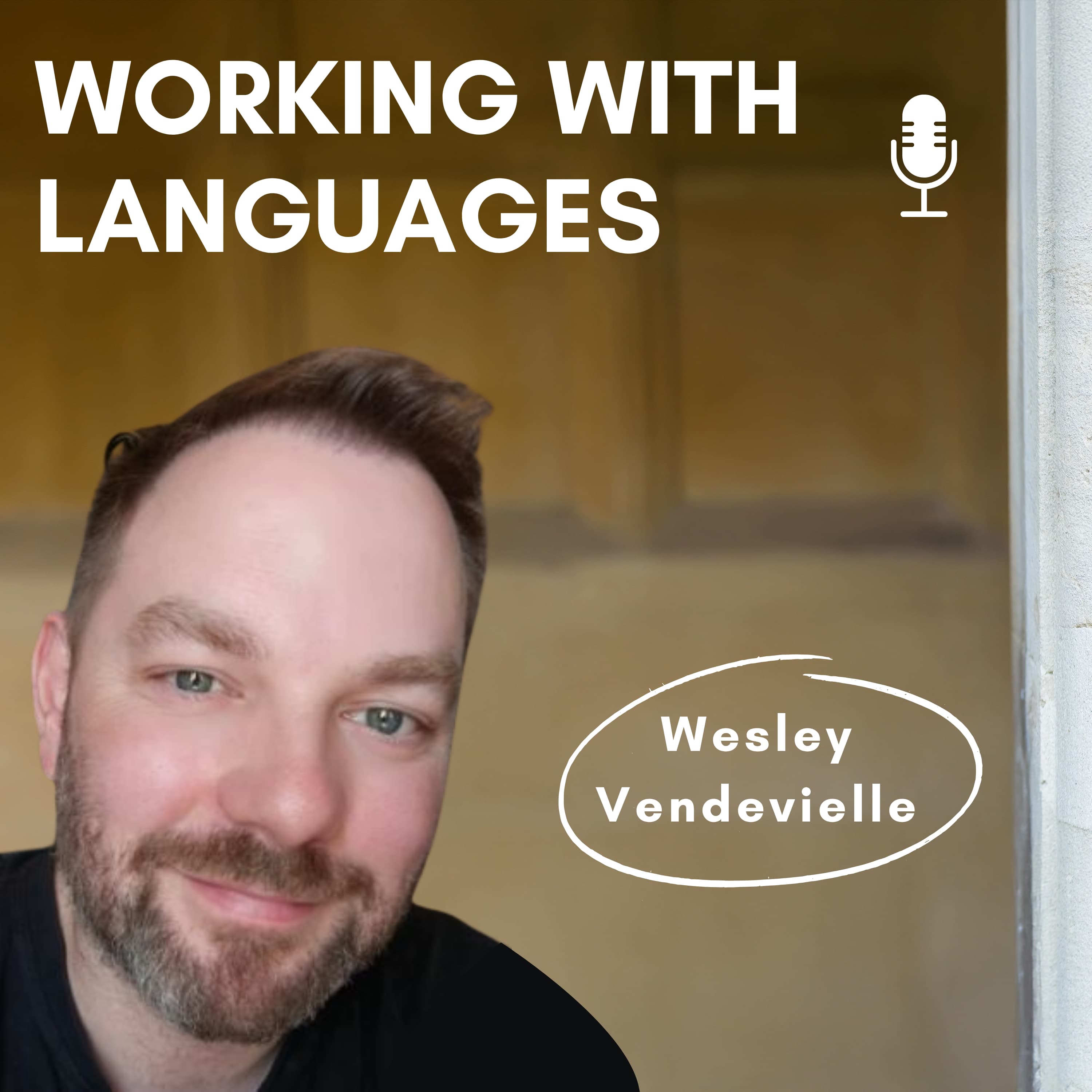
Today’s guest on the podcast is Wesley Vendevielle, who is a Dutch language and culture coach, not just a teacher, but really a coach, and we’ll get into that a little bit later on. But first of all, hello Wesley.
Wesley Vendevielle: Hello, Sonia. Thank you so much for having me.
Sonia Kampshoff: It’s a pleasure to have you here. As you know, I like to start the podcast asking, I guess, um, what I call a fun question. What is your favorite word or a phrase, uh, in a language that you speak.
Wesley Vendevielle: Yeah, that’s a funny one. I will go with a Dutch one uitwaaien.
Sonia Kampshoff: What does it mean?
Wesley Vendevielle: Yeah, out. It’s, it’s, it’s very weird to translate probably. But the meaning is that you go to the, to the beach and you let the wind get you, what do you mean? So you go to the beach normally when it’s, when it’s windy, people stay home. Uh, but Dutch people, they have a thing. They like to go to the beach or to, to a place where they can enjoy the wind and just let the winds be so all your worries will go away. All your thoughts will go away. And that’s what the word uitwaaien means.
It means to blow out, which is, translates horribly in English. Uh, probably, but means that you go to a place and you stand in the wind and just let it be, you let the wind take your worries away.
Sonia Kampshoff: Oh, that’s nice.
Wesley Vendevielle: Yeah. And so you can, you can either spend a lot of money on a good psychologist, uh, or a therapy or a yoga session, which is all lovely, but one can also go to the beach, uh, when it’s almost storming and, and just stand there.
Sonia Kampshoff: uitwaaien. Nice. Very nice.
Wesley Vendevielle: Maybe, maybe a storm is a bit over too much here, but very nice.
Sonia Kampshoff: I’ve never heard of that expression anyway.
Wesley Vendevielle: Yeah. Yeah. I think you need to be a little bit crazy for that. Uh, so in the Dutch, uh, the Dutch way of crazy, maybe that’s a good one. Yeah.
Sonia Kampshoff: So you are Dutch. Um, is that where you grew up in the Netherlands?
Wesley Vendevielle: Yeah, I grew up in the Netherlands, yes. I’ve spent my whole life, uh, well, uh, the biggest part of my life in the Netherlands. I grew up in, uh, a province called Zealand. Uh, it’s in the southwest of the Netherlands. Notorious for having, uh. A nice storm every now and then.
Sonia Kampshoff: It’s on the beach, isn’t it?
Wesley Vendevielle: It’s on the coast, yeah. Yeah. Yes. It has a beautiful coastline. So when people think about beaches in the Netherlands, they think about populated places, um, zone for ravening and the really crowdy ones, the ones that you Google, hotspots that you will go there. Uh, but sail has very nice, quite beaches apart from the summer, of course, where we have an invasion of tourists in the summer, but apart from that, it’s nice and cold.
Sonia Kampshoff: Great. So tell us, uh, about, you know, your, your upbringing, your career. I know you had a first career and now you have your second career. What, what did that look like?
Wesley Vendevielle: Yeah, so my career is not really a, a typical one. Uh, I would say. Um, I started my career off in the military in the Dutch, uh, air Force. I spent my, well, almost half a year there. I spent 16 years in the military. Uh, that’s a long time. Made me to the, to the man who I am now. I would say I had ups and downs there. But eventually I transitioned to what I’m doing right now and that’s having my own language school, uh, in Talk Dutch today.
So nowadays I help experts, professionals, and everybody who needs it, uh, to become fluent in the Dutch language and, and comfortable in the Dutch language, whether that’s for work, social activities, or for integration purposes. To get by in daily life. So you said you, you spent 16 years in the Air Force, which is quite long time, and it’s quite a different job and career than the one you have now.
Sonia Kampshoff: So what, um, what made you change and what, um, skills that you could, uh, take over from the, from the Air Force, from the military into your new coaching career?
Wesley Vendevielle: Well, in the military. Uh, a language is a very big part. Not as, as much as language skills as English, German, Spanish, Dutch, but like communication skills, that’s very important. I think that’s one of the biggest, um, things, traits I take from the, from my career in the military. Uh, I’ve worked quite some well in NATO as well, where you have to deal with, uh, a lot of different cultures, different languages, but also different attitudes. Different habits. Everybody does things their own way. Um, and you need to be able to adapt, integrate, you need to find your way in that, uh, in that lifestyle.
Sonia Kampshoff: Do you find that the Air Force and the military in general, do they put a lot of training and emphasis on communication and cross-cultural communication?
Wesley Vendevielle: That’s a very good question. No, I think the military is very, may I say pragmatic, the, the military is pretty straight forward when it comes to that.
You need to get your, um, you need to get your point across and it needs to be done in a short time and concise and a very precise. So I don’t feel like there is a lot of focus on, um, cultural differences, for example, apart from. The programs, for example, Americans have, when they come to Europe, they’re being informed, okay, things work a little bit different in Europe than in the states. This and this, uh, are the differences. But that’s very local, I would say.
Sonia Kampshoff: Okay. You’ve had, you mentioned you also worked for NATO, uh, for a while. Um, do they do it differently because there’s a lot more cultures, um, among the people working at nato.
Wesley Vendevielle: Yes. Well, where I worked, um, I worked on, uh, in allocation, uh, as an Air force base. I flew, uh, aex there for a couple of years and not as an, uh, pilot, but as an air crew, I was a surveillance operator there. No, I haven’t seen much of that. Uh, you really need to have it in you to be able to understand the different cultures or willing to adapt and learn and yeah, observe. And that’s, that’s what I, that’s what I always found fascinating about working with different cultures, languages that you, you actually can learn a lot from them.
Sonia Kampshoff: Yeah. Do you have any anecdotes that you can share about things that maybe went wrong or went right, but funny?
Wesley Vendevielle: Yeah. Do have. Um, I have a lot of anecdotes. Um, you see that Dutch, uh, persons are a lot direct, very direct, and that can, uh, cause sometimes a little conflict with, for example, a Italian person or a Spanish person that’s, um, is not as straight to the point as a a German or a Dutch person.
Sonia Kampshoff: And I would say that, uh, nowadays. Hierarchy is also pretty flat in, in the military?
Wesley Vendevielle: Yeah, in the military at least where I worked, uh, the hierarchy was pretty flat. Of course, you respect, uh, your elder, you respect your, uh, superior, but you can call your commander by the first name often. This is something that’s unheard of in the US Air Force, for example.
But this also counts for giving feedback or. Unsolicited advice, like advice that nobody asked for. Dutch, Dutch persons, I think, are pretty, uh, notorious for that, uh, to standing up or speaking up for something that’s, that’s on their plate, let’s say. And this can cause sometimes a friction when you do that with, um, an Italian or Spanish, uh, or doesn’t matter, uh, superior some, somewhere where the hierarchy is less flat.
Sonia Kampshoff: Interesting. And now that you are coaching, um, experts, and I’m assuming that you’re mostly coaching, uh, business people, so not, uh, experts in terms of army people moving to different places, but you’re coaching mostly business people.
Wesley Vendevielle: Yes. Uh. My clients are indeed in, uh, in, usually in corporations like, uh, Shell or Shimano, uh, Heineken, those companies. Indeed. Yeah. And there are business people who come from other countries to the, to the Netherlands, work for a certain period of time. Mm-hmm.
Sonia Kampshoff: Um, and you find there’s a, a good crossover from what you learned in your first career to what you’re doing now? In terms of communication also, you know, flat structure or not flat structure.
Wesley Vendevielle: Yeah, it’s, it’s strange. Um, it sounds like the military is of course way more direct and, uh, less, uh, empathic. Um, but I think I have the empath side, uh, in me, uh, so to say. Um. But yes, I find it very, very useful, uh, to have this experience in nato to understand how, um, how other cultures work, how people communicate it’s, it’s often about details that you can’t learn from any textbook. I think, I think you need to experience this.
Sonia Kampshoff: Tell us more about your second career now. Um, how did it come about? How did you get the idea and how did did it develop in what It’s today? So after 16 years in the military, I really had to stop.
Wesley Vendevielle: It was also my body, my mind telling me enough is enough. And I had a lot of signals for that. I started to make mistakes in my work and, and, and really, really serious mistakes during assimilation and, and in flight. Um, we had assimilated exercise, assimilated emergency. We always did that during the flight to train your drills, like if something happens.
What do you do? Everybody has their action. Everybody has their checklist. Everybody has their reaction, what they need to do. Everybody has their protocol, and you do this every flight. So it’s a routine. So in case something happens, you know what to do. And simulated emergency starts. And I found myself in a complete stress reaction, eh?
So your body goes, uh. It freezes or your fight, or your flight. I froze. I didn’t know what to do anymore. That lasted for in my mind, 6, 7, 8, 9 seconds. And I was too late with everything. Everybody died, uh, simulated. Nobody died in real, it was a simulation and it was my fault. So I thought, okay, this is, uh, a serious sign that it’s not going anymore.
So this was very openly. My reason to stop the military. Yeah. And it’s, it’s interesting to see that a simulation like this, the first purpose of it is to train you to, um, have a fake situation that could actually happen in real life and train you in it. But it also, it also has this secondary benefit of, you know, just seeing where you are mentally and uh, physically with your body.
And if anything like this, I mean, do you really do that? That’s, that’s what I wonder. Do you really do that? Like in life, when you get science, do you, do you stop and say, okay, this is, this is enough? Because we all know the science, everybody has been or close to a burnout or to some, some kind of a level that you don’t function anymore.
I mean, I think most people can relate. So then you decided to, um, quit, uh, the Air Force, your first career, and after a break you decided to become a language teacher. Yeah. That sounds funny, isn’t it? It’s certainly a different career. Yeah, it is a different career. Yeah. So to be checked at, no, I started off as a burle, as a, a language in instructor, a Dutch language, uh, instructor.
And that went, that went very well. I mean, I loved it. I loved the people. I loved the, the work. I could work from home. So after my, uh, recovery, that was a fortunate thing, but because being in the military, you’re wait quite some time and now I could actually provide from the safety of my own house, I didn’t have to commute.
It was wonderful. And this escalated. Uh, to where we are right now. I don’t need to tell anybody that working for a corporation as a freelance was not quite ideal. Let’s keep it like that.
Sonia Kampshoff: You, you were freelancing at Berlitz? Um, I was freelancing at Berlitz, but it went so well that people asked me, Hey, can you teach my, uh, can you teach my son in the weekends? And I said, no, no, no, no, no. I work for. I am an extreme loyal, uh, uh, golden retriever. Like, no, no. I worked there, you know, having served, uh, 16 years in the military, I think I know a, a thing about two of being loyal. Um, so no, I didn’t, and I had many, many, many questions and I never did it. I worked very hard and all the statistics, all the KPIs went, uh, through the roof.
But the compensation wasn’t quite there, and I moved in a meanwhile to Turkey. It’s not a secret that, uh, often, uh, corporations pay according to, uh, location. It’s, it’s, it’s not nice to say, but apparently that’s how it goes. So I experienced that. I was like, okay, I’m a freelancer. I’m not tied to, to anything.
I’m gonna start my own business. This is something I can do and I’m pretty good at. I’m gonna help people fire my own platform. And this is how it started. So you now have your own business and you have your own clients. Is there, is there a lot of word of mouth, you know, do people refer you on saying, oh, you know, I, I learned my language with Wesley.
He is good. And, and refer you on essentially. Yes. This is actually how it grew really fast. Word of mouth. Yeah. In the beginning there wasn’t a website. There was not, uh, there was nothing. Now, now there is everything that, that there is a website. I worked with marketing, I worked with, uh, learning and developments, uh, specialists to set up, uh, we have everything now, but in the beginning it was only word of mouth.
Sonia Kampshoff: So you now have even your own books for teaching language and culture?
Wesley Vendevielle: Yes, but uh, not published yet. We are working on it.
Sonia Kampshoff: Okay. That sounds very exciting.
Wesley Vendevielle: Yes. The Q1. Next year I’ll be, you’ll be the first one I’ll send a copy to.
Sonia Kampshoff: Thank you. I’d love that.
Wesley Vendevielle: Uh, the first one is gonna be a culture, uh, book, but a little bit in a, in a funny style. So. Uh, to, to give a little, uh, insight. It’s going to be quirky Dutch cultural habits. That’s. Uh, nobody really talks about out loud, but we do it in a, in a book.
Sonia Kampshoff: That sounds good. Um, I’ve had a look at your LinkedIn.I can, and I can see that you publish quite regularly, uh, ideas and examples of these quirk key mm-hmm habits of Dutch people.
Wesley Vendevielle: Yes. It’s, it’s, it’s going to be, uh, something like this. It’s going to be a collection of, uh, of those things. I’m more, um, when I first worked with. My marketing, uh, specialist, uh, she really helped me. Her name is Patricia. If you listen, you’re awesome. And we found each other through LinkedIn. By the way, I found her, one of her posts resonates with me. I was like, Hey, that’s the person I, that, that’s me. Like we should, we should do something together. So we worked together for, for nearly six months and yeah, it was great.
She asked me, what is your favorite social media? I said, well, you can as well ask me what is your favorite eye disease? I don’t, I don’t like it at all. I don’t like social media, but I have to say LinkedIn proved me wrong. If you may count it as a social media, LinkedIn is awesome. I can see you’re quite active there. Yes. Yeah, it’s, it’s, it’s great. The community is awesome. A lot of collaborations, uh, sharing knowledge, sharing interests. It’s, it’s wonderful. Great.
Sonia Kampshoff: So do you only teach, um, from English to Dutch or other, do you cover any other languages?
Wesley Vendevielle: I don’t co cover any other languages. Um, so it’s, it’s, it’s, we teach Dutch, I teach Dutch. Um, I say we, because we are currently, uh, expanding as well, but no, it’s, it’s Dutch. Yeah. And if it can be done in a Dutch way, we do it mostly in Dutch. If we need English, we need English, that’s fine. Or a little bit of German. Uh, that’s also fine.
Sonia Kampshoff: What are your plans for the business? You said you’re bringing out, uh, your own coursework and next year and you’re expanding to new teachers and coaches. How do you see it expanding and engaging with more clients who need this, this kind of coaching and training?
Wesley Vendevielle: Well, I think this is going to be very, very awesome. It’s gonna be an awesome journey. The, the clients, the clientele we have now is, is they’re amazing, amazing people. They bring in new people. So what I focus on is not just teaching Dutch, but uh, in a personalized way.
So let’s say, if you want to learn Dutch, I, I will like to know why is it for your work? Is it for social integration? Is it for an exam? And we built the coursework, especially, especially for your, for you. So the co the coursework will be, uh, heavily, uh, personalized, but not only to your goals, but also to what kind of a person are you, how do you learn?
We also adapt to that. So there is not one, uh, size fits all, uh, program, but it’s, it’s, it requires a lot from the. Teacher or coach in this case to understand the, the client to understand the client’s needs.
Sonia Kampshoff: What kind of ways of learning can you see in your clients?
Wesley Vendevielle: Ooh, some, some, some persons, uh, they like to read. Some people like to. I have, I have quite some engineers, uh, in, in, in, where you can almost make language like a formula. Like you can make a sentence or you can make a formula out of it and, and all of a sudden it clicks. Okay. That’s why this word is coming there and this word there. So we are looking at this level of personalization and, and to get back at your previous question, because I think I forgot to answer that in my, uh, enthusiasm about this.
I’m, I’m looking for more teachers. Coaches with a superpower, empathy, adaptability. Um, I’m looking for, uh, people that are really into helping other people achieving their goals their way. This is what I really want. So I’m honestly, I’m not looking for a perfect teacher. I, I, I dare to, to say that I’m not a perfect teacher myself. It’s, it’s not about this. It’s people want to feel understood. People want to feel, um. Helped in, in, in their way.
Sonia Kampshoff: Is that what you think makes you a good teacher?
Wesley Vendevielle: Yeah, I think the, the, the social and the interpersonal skills are really, really important in this, uh, in this, uh, in this business. We’re, we’re dealing with adults. We’re not kids. Everybody has their life. Everybody has their career. Everybody is something. It’s, it’s not about being perfect, it’s about being natural.
That’s what, that’s what makes me, yeah, I, I don’t know. It’s, it’s weird to say about yourself, but successful things are going very good. People are very happy. So it’s, it’s amazing. Is it what you would’ve expected, uh, straight after the military? No. I remember my, uh, intake with a recruiter of Buress and my, my camera didn’t work. My sound was my bad. It was my, my fault. And, uh, she said, yeah, I just wanted to check, are you really from, I mean, are you from the military? What, what is this? And my camera didn’t work, and I said, yep. She said, I think I need pause because we don’t need that kind of people. My camera works. You can see I’m relatively a normal person, nice person.
Uh, and I think, uh, it should work. Yeah, no, it’s not what I expected after the military. Uh, so yeah. How long do your students stay with you? Um, do they, do you coach people for months or is it maybe even years? Um, some, um, some are there for only a short period of time. It’s, it’s, it’s also depends on their goals.
All right. Um, do they have, are they already at a certain level and do they have an interview to pass or an exam to take? Then we can do it relatively quick, but then again, some people take a little bit longer. Uh, because they take one lesson a week or one and a half hour a week, and, you know, business trips happens.
People are sick. I, I have kids, everybody has a life. Uh, if something happens, then yeah, it can take a a bit longer. So some people stay for, I dunno, I have people for two years and they progress slowly. But that’s okay. They don’t have a hard targets and sometimes we have really hard deadlines. Okay. The exam needs to be done before this and this date.
Okay, let’s go, let’s do it. That’s wonderful. Or I have an interview on Monday, uh, very unexpectedly, um, at this, this level. Can you help me for a few hours? Sure. We can mock it, we can role play. This is what we do a lot. We role play a lot based on the student’s client’s needs. Yeah. I read into the vocabulary, what do they need?
And um specific for some people work in finance, other has a management function, um, others needs to do, uh, yearly, uh, progress talks. So it’s, it’s, it’s a bit of everything. Interesting. No. I mean, yes, I find it, I mean, I can talk for hours about this, but this is, uh, this is wonderful. Um, people from all over the place with different functions and being able to help them in their work, in their vocabulary.
Some people get a promotion out of this, or some people show me their exam overview and they pass everything. All the integration exams are on green. It’s the best message you can give. I always tell people when you do an exam, it’s also my exam and I really take it serious. When, when people have an exam to pass, you bet I’m going all in to help you with it.
Sonia Kampshoff: And the coursework that you developed, is it, is it printed or is it online? Do you use a specific software?
Wesley Vendevielle: No, we made it, it’s, it’s in our notion, in our, uh, page, let’s say our company page, we have it internally. It’s not published, uh, but it’s our, it’s our syllabus. Um, based on European standards reference, um, to guide somebody from zero to a two.
Because also, yeah, we basically made a whole onboarding, uh, system or my, uh, learning and development specialist. Marina, if you listen, you’re brilliant. You. Um, it’s, it’s also for the, for the new coaches. Yeah. They, they need to have, they need to have guidance. They need to have something to hold onto to say, okay, we go from this chapter to this chapter.
It doesn’t mean that there is a one size fits all, uh, approach because you still need to see how you can help this person best. Okay? You need to go from A to B, you need to be able to introduce yourself, but how you do this, how you teach this. Uh, it is also based on the, the client’s needs or the students in this case.
Yeah. Do you two, do you use any specific technology other than, you know, having video calls with them? Yeah, I use AI a lot for, um, uh, developing the nice cartoons. I, I prompted, uh, ChatGPT very nice for my cartoon series. So it’s, the style is always the same. Uh, it’s, it’s always universal. So when I have an idea about a Dutch word.
Or about, um, uh, something that needs to be addressed or something that I have on my mind, I dunno, some inspiration for a post. I can, I can give the command to, uh, to ChatGPT. You really need to give it good guidance, good instructions, which they call prompting. Um, yeah. And that’s set up nice. So that’s, that’s what I use.
Sonia Kampshoff: And do you use the cartoons? I can see them on LinkedIn. Do you use them in your coursework as well?
Wesley Vendevielle: They’re going to be maybe, yeah.
Sonia Kampshoff: Sounds really good. Do you use AI in your personal life as well, or try to keep a distance?
Wesley Vendevielle: No, uh, I use it for my personal life as well, and, and I, I don’t trust the AI blindly, but to structure, to structure ideas. I, I like to use it for that. I often have, I dunno, when you have your, uh, best, uh, ideas popping off, but when, when those ideas pop up, I need to put it in, uh, ChatGPT and um, or in a notepads or, uh, anywhere but later I’ll upload it to ChatGPT and I start to brainstorm how to structure this. What am, what am I looking at?
How to, how, how can I get there? Um. And I find it very helpful. So yeah, that’s how I use it, I think is a, as a companion. Yes. But also I prompted that. Don’t say only. Yes. Uh, you know, like argue like give me pros, cons, uh, look at it objectively. Don’t say, oh West, this is a brilliant idea. No, I don’t want to hear that.
’cause it has a tendency of doing that, right? Yeah. It does compliment you a lot. The most things I’ve learned is from really hard and honest feedback. So as far as, uh, AI comes, look at it from 10 different angles, please, and then I’ll form my opinion myself. It can also be useful for if you need quick inputs for, for a lesson. It can also be, or a reference or if you need inspiration. Yeah, I find it very, uh, I find it very nice.
Sonia Kampshoff: And where can people find you online?
Wesley Vendevielle: People can find me on LinkedIn and uh, a website. Well, thank you very much for your time and your chat.
Sonia Kampshoff: Uh, Wesley, it was a pleasure, uh, Sonia and, uh, looking forward to speaking to you again.
Wesley Vendevielle: Anytime soon. Great. Talk to you soon. Bye. Bye-bye.
Sonia Kampshoff: Not all veterans go on to become language teachers or coaches. The Air Force taught Wesley good communication skills and an understanding of how to achieve goals. His language coaching is tailored to his students and that is the cornerstone of his success and why he gets referred on so often. He turned burnout into a new successful career, and that is admirable.
If you enjoyed this conversation, please follow and subscribe to the podcast and share it with a friend who may enjoy it too. And if you’d like to suggest a guest or want to know more about sponsorship, please get in touch at the email in the show notes.