Sonia Kampshoff: Welcome to Working With Languages. My name is Sonia Kampshoff – I’m your host and a multilingual digital marketing consultant.
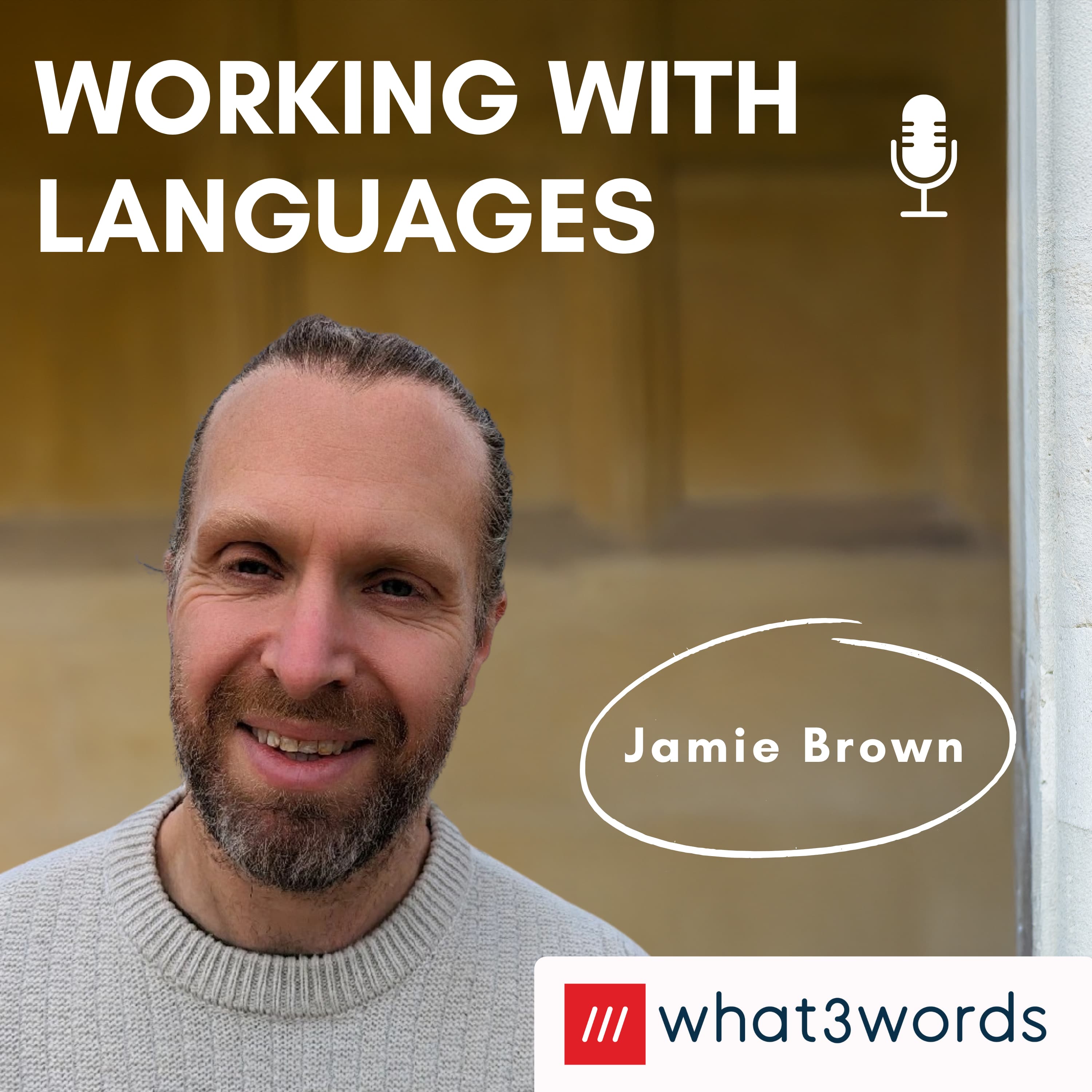
When I came across Jamie, this episode’s guest, I was fascinated by his background and his multifaceted career path – and I knew I wanted to talk to him on record.
This is a very personal and open conversation about achieving more than he would have dreamed of as a kid – being a composer and linguist despite his stammer.
And his work at What3Words – the location finding system – is meaningful and can save lives.
Let’s dive in.
My guest today on the podcast is Jamie Brown, who is a linguist and worked for almost 10 years at what3words as the Chief Linguist. Um, so Hello, Jamie.
Jamie Brown: Hi Sonia. It’s so nice to be here. Thank you very much.
Sonia Kampshoff: I came across you online, uh, recently when I was doing some research on a podcast, and I, and I was fascinated by your background and your story.
And I’m very, very happy to have you here today on the podcast. It’s, um, it feels very special. So, as you know, I like to start. With a question for my guest, which is, what’s your favorite word or phrase in a language that you speak?
Jamie Brown: That is an excellent question. I have gone a bit rogue actually. I hope you don’t mind.
Um, I’ve actually chosen the word in a language that I speak a bit of but can’t claim full fluency: Cornish. So lots of my family’s from Cornwall. I’ve grown up with a lot of Cornish words round here and there in life. In a previous life I was a music composer and I wrote a requiem mass in the Cornish language. And one of my favorite words from that setting is the word gooth, which in Cornish, uh, means pride. And you know, that’s a very big part of the Cornish identity. So that’s my word. Beautiful.
Sonia Kampshoff: I didn’t expect a Cornish word, but then you are master, I think, or at least a little bit of so many languages.
Jamie Brown: Yeah. I quite like having that sort. Broadness of experience. That sort of goes in my personality, I think.
Sonia Kampshoff: Yeah. So tell us, tell us more about yourself. Where, where’d you come from? Uh, where did you learn the languages that you speak?
Jamie Brown: Well, I grew up in the UK and you know, I come from a pretty monolingual background. None of my family really speak any other languages fluently. But when I was at school, I realized that I was really interested in, uh, languages.
Um, I was actually quite interested in them from a sort of academic perspective. I really liked understanding how languages fitted together and how you sort of use them in different ways and how those building blocks of the language. Build into something like a sentence or a conversation. So that’s really where it started.
Well, from my entire childhood and, you know, into my adulthood, I actually had, uh, quite a bad stammer. I couldn’t even get through one sentence in English really for the majority of my life. So sort of that whole being a linguist thing didn’t really feel like something that was available to me. So I sort of, you know, maybe like retreated into a corner and just sort of started to learn about how yeah sort of the stuff behind the conversations, you know, sort of, um, how languages expressed different things in different ways and how.
Um, how different words are made in different languages and what’s the reason for that, and how languages relate to each other and link up across the world. So that was really how I started.
Sonia Kampshoff: Fascinating. So did you travel abroad when you were a kid with your family on holiday, or did you spend most of your time in the UK?
Jamie Brown: Um, mostly in the uk. So I grew up near London, but like I said, you know, I’ve got very close family ties to Cornwall. So Cornwall was where we were in the summer holidays. Uh, but like I said, um, I was sort of beavering away in the corner at learning languages and being interested about the world.
Um, so I had a few pen pals around the world, one of whom was Icelandic. So I decided that I would learn how to write her letters in Icelandic.
Sonia Kampshoff: So you, you wrote each other letters in Icelandic?
Jamie Brown: She wrote to me in English, and I wrote to her in what I can only assume was extremely bad Icelandic.
Sonia Kampshoff: Fascinating.
Jamie Brown: So I traveled sort of from the confines of my own room maybe.
Sonia Kampshoff: Are you still in touch with her?
Jamie Brown: I’m not. No. Sadly, I, I wouldn’t know how to get in touch, but, uh, we lost touch a few years ago.
Sonia Kampshoff: Yeah. So you mentioned that you are a composer. Is that, that’s, uh, if I remember correctly that’s what you first studied at university, composing.
Jamie Brown: Yeah.Music is a language. It’s all very closely related. I likes the languages as a child, but I had a stammer, so I didn’t really feel that it was open to me.
Um, and music is just the other side of that coin, isn’t it? And the good about being a musician is that you don’t have to talk to people. At least you don’t have to talk a lot to people, particularly not in public. Um, the way to really not have to talk to people is to be a composer because then, you know, quite like writing to my Icelandic pen pal.
Um, you can do a lot of it from your own room with a piano, with some transcribing software, um, and, you know, write whole symphonies and operas, which I did. Um. Connect with people, people in that way using language but not having to speak it yourself. So yeah, I went to university, studied music, uh, specialized in composition.
Sonia Kampshoff: And when you composed music, did you write the music only or did you write uh, the lyrics as well?
Jamie Brown: Mostly music only. But you know, in my sort of interested in languages persona, I guess I wrote lots of music in lots of different languages, so like I said, I wrote a, um, a, a requiem mass in the Cornish language.
I wrote stuff in Finnish and Swedish and Latin and Portuguese and French, you know, all these sorts of languages that, you know, I would find something that I was interested in. I would work with a linguist who would sort of help me to understand sort of how the text fitted together, how it was pronounced, how I would best be able to sort of represent it in music. So that was, um, particularly interesting for me.
Sonia Kampshoff: How did you decide: today I want to compose something and have the lyrics and finish. Why, why would you decide on a specific language?
Jamie Brown: Often it was a particular interest, you know, like I’m always interested in languages. Like I said, I’m a bit of a magpie, you know, I pick up on a lot of things from a lot of places. My interest in Finnish is actually quite interesting. As a sort of teenager and early adult with a stammer, I started to get a little bit sort of obsessed with the idea of is there a language out there that I don’t stammer in?
Because you know, stammering such a sort of phonetic thing in particular sounds are problematic to particular people. And I sort of, you know, I knew that I stammered extremely badly in French, worse than I did in English, but I sort of started to look around, um. And I actually went to Helsinki on holiday with a friend in my early twenties and found that actually for some reason Finnish was quite an easy language for me to say out loud.
So then I started to sort of delve into it a bit more and got interested in Finnish poetry, which sounds ridiculous to me. Sounds ridiculous for somebody who doesn’t speak it and is interested in. I’m really interested in how languages sound and like the combinations of the consonants and the vowels and the, yeah, just that sort of sound world, I think.
Sonia Kampshoff: Yeah. And also I guess how the, how do we move the mouth and the tongue when we speak a specific language?
Jamie Brown: Yeah, exactly. And as a stammerer growing up, I was absolutely obsessed with, I just couldn’t wrap my head around the fact that some people were able to produce sound without having to think about it. And I would really sort of studied people’s mouths as they were talking.
Like I’d really sort of, and this sounds a bit weird. Sort of eye contact is king, but actually I was really watching people’s mouths and sort of wondering like, how are you doing that without any sort of physical problems with producing all these noises that I knew I wasn’t able to. Um, so I guess that all ties into it as well.
Sonia Kampshoff: Yeah. But you know, as someone who has learned languages, I know that, especially at the beginning when I learn a language, I just look at the mouth of a person, I stare even, because it, it feels like easier to understand what they’re actually saying rather than looking in into their eyes. So there’s, there’s something common there.
Jamie Brown: Yeah, absolutely. And I guess, you know, that’s tied into, um, tied into lip reading, isn’t it? And sort of somehow that can relate it slightly more closely to the written word than if you’re looking at the eyes. Yeah. And obviously, you know, as a learner, it’s easier to, to read than to listen. I’d never realized that actually I wasn’t the only one that was slightly weirdly, uh, transfixed on people’s mouths.
Sonia Kampshoff: I’ve done that a lot. Yeah, I’ve done that a lot.
Jamie Brown: Good. I’m glad to hear it.
Sonia Kampshoff: So, at some point, um, after your music studies, you moved to Brazil?
Jamie Brown: Yes, I did. I sort of worked for a while in the music industry. Um, and then a quite long-term job came to an end and a couple of other things were happening in my life and in my late twenties.
I thought it’s now or never, move abroad whilst, you know, everything’s aligned in the right way to let you do that. So the story goes that I stuck a pin in the map. It was actually slightly more focused than that. I ended up in a city called Belo Desag in the southern part of Brazil. And yeah, there I was.
I thought I was gonna try and get a job as an English teacher. Brazil’s one of those countries where, you know, basically every street corner has an independent language school. Um, most people want to learn English, so I assumed that that was gonna be easy. I must say at this point my stammer was improving. I was, I was able to control my sound a lot better, which quite often happens to people as, as you move through your twenties, stammers that were quite bad as a teenager can often sort of start to level out. So that was already happening.
And to cut a long story short, I didn’t get a job as an English teacher, but I did get a job as a receptionist in a language school. And it turns out that one really good way to learn a new language is to get a job where you have to answer the phone every day.
Uh, so I did that. It was a really sort of life affirming time for me for a number of reasons. You know, traveling abroad, being independent, meeting new people, that’s sort of all, all of that good stuff. But also because big, because I have a sort of, I am naturally quite good at learning languages. I learned Portuguese really quickly and people started to compliment me on my spoken language, which is something that was extremely rare in my life.
You know, like being complimented on how I spoke was the exact opposite of what happened my entire life. You know, people were sort of always a bit confused or surprised about my stammer, you know? Um, and it was never something that I felt good at. So to have all those compliments was actually. It really reminded me that actually my first love was languages and that maybe this actually was something that was available to me as a career. So I came back from Brazil and enrolled in a master’s in linguistics.
Sonia Kampshoff: Who were the other people at, uh, uh, studying linguistics with you? Were there people with a similar interest with you or was there, is there a range of people really?
Jamie Brown: On the master’s course?
Sonia Kampshoff: Yeah, it was a real range of people actually. So I studied at Beck College, which is part of the University of London. Um, it is a great place to be but one of its usps, I guess, is that the lectures are all in the evening, so it’s sort of particularly for people who are working as well as studying. So I would go up to Russell Square on a Tuesday and a Thursday after work, sit in lectures, and you know, there’s a massive range of people from all stages of life.
You know, people who were actually 21 years old and fresh out of their undergrad. Up to people that had retired and were just interested in linguistics. Um, people who had some language element to their job or people like me who felt like it was something that they wanted to pursue and potentially work in.
Um, at that time I thought I was gonna become a translator. Um, I had learned Portuguese obviously. So I thought I’d be a Portuguese to English translator, but had that sort of academic interest in linguistics as well. So wanted to see where, where that would take me long term.
Sonia Kampshoff: And once you finished your master, what was the first job that you had that involved languages or linguistics?
Jamie Brown: Well, when I was doing the master’s, I was working at, um, the, uh, the Institute of Psychiatry, which is part of Kings College London. I was working in the team for education there, which was super interesting. But quite soon after I finished my master’s, um, something really unexpected happened.
One of my friends posted on Facebook, do I know anybody who loves languages and Microsoft Excel? I might have an interesting proposition for you. And I was like, those are my two favorite things in the world. Me, me, me, me.
Um, and to cut another long story short, she was asking on behalf of a friend of hers who was starting up a company called what3words. Um, and they were looking for somebody who was interested in languages and was interested in sort of language research and product building in, uh, lots of different languages.
I’m not gonna call it translation because it wasn’t quite as simple as that, but sort of in that general localization building, um, research type area.
And it was sort of like help them out for a few hours a month. So I did that alongside working at the IOP. And then after a while, that became my full-time job and the company grew and grew and grew. Um, and I was, yeah, extremely lucky to be there pretty much from the beginning.
Sonia Kampshoff: That sounds, uh. So, you know, uh, by chance really that you found this job, um, through a friend on Facebook, posting something on Facebook, um, but also to be there from the very beginning feels really incredible.
Jamie Brown: Yeah. So lucky. And I think, you know, so much of those startup-y opportunities really are about that, you know, is about saying yes to every opportunity and, you know, seeking stuff out that you might be interested in doing. Yeah. Absolutely. ’cause you never know what crazy things somebody’s trying to do and how you might be able to help them out.
Sonia Kampshoff: Absolutely. For listeners who may not know, can you tell us really briefly what what3words is about?
Jamie Brown: Yeah, sure. So what3words is a global addressing system. Basically what it’s done is it’s divided the entire world into three meter squares and it’s given. Each one of those squares a unique three word address. So a string of three words that is unique to that particular square on the planet.
So for example, my home, the front door of my house is inside one of these three meter squares, obviously, and the words for that location are flags-livelyy-clash. So if I want to tell somebody exactly where I live, one way that I can do it is to say, um, my what3words address is flags-lively-clash.
Download the free app, or they can use it on their desktop. It’s where there is a search bar, and it takes you directly to where I live, which is useful in a number of ways. You know, it’s particularly good for talking about places that don’t have a regular street address. Or have a bad street address.
You know, there’s so many different places in the world where, you know, if you’re in the middle of a forest or if you’re on a beach or if you’re in, uh, the countryside, you know, there is no way of, um, in a sort of human friendly way telling somebody exactly where you are. Obviously there’s GPS coordinates, they’re that long , uh, but that’s prone to error when a human is sort of reading out strings of 10-12 numbers at a time.
What3words is just that sort of human friendly way of remembering, that way of describing exactly where you are. The words are all completely random, so obviously flags lively and clash have no relation to each other. They don’t describe the front door of my house in any way. It’s completely randomized.
It’s just a string of memorable words that people can use to tell you exactly where they’re,
Sonia Kampshoff: yeah, so I use it. Um. Quite regularly actually, for example, I, I go, um, to the airport by car and I leave my car there and you can just imagine, you know, there’s hundreds and thousands of cars there. So I just, you know, mark where my car is parked, I don’t have to think about it when I come back.
And it’s just so convenient because it just takes you there. Yeah, and I can somehow, you know, there’s so many users for it. So, you know, for example, in an emergency when you are in the middle of nowhere and people, you need people to come and, um, rescue you or come to you, or even in places with, um, addresses that are not very clear or, um, addresses, you know, that, that are not easy to understand or when there’s, there’s so many in the UK for example there’s so many roads that are called Kings Road or Queens Road, you know?
Jamie Brown: Yeah, absolutely. You know, the number of times you type something into Google and you don’t really look at, um the option that you’ve selected and it’s actually not the right thing. Yeah. What3words takes all of that away. And like you said, with the emergency services, you know, is a lifesaving system as well, you know?
Um, so in the UK you can tell a nine, nine, nine call handler your what3words address and they’ll know exactly where you’re, they might even prompt you, uh, to give it to them. If you ring them up, you’ve had a car accident on a road in the middle of nowhere that you don’t know, and they ask you where you are and you say, well, I don’t know.
I’m on this road between here and here, but otherwise I don’t know, they will then at that point, quite like you ask you for your what3words address, you know, helps emergency services get you quicker.
Sonia Kampshoff: Yeah, absolutely. It’s much better than saying, oh, I see a lot of trees.
Jamie Brown: Exactly. Yeah.
Sonia Kampshoff: And there’s also a commercial use behind it, you know, emergency services, but also logistic companies, you know, um, postal companies. So that’s, I find that very, very fascinating because it’s not purely a linguistic product. It has a real use and a commercial service behind it, which, which means that you were able to develop it in a lot of languages.
Jamie Brown: Yes. Yes, we did. So over 10 years, we launched, uh, 61 language versions of what3words. And, uh, the tricky thing about it and sort, this is going back to, um, what I was saying about it involving a bit of research, you know, it wasn’t sort of pure localization, you know, it won’t come as a surprise to you or your listeners, um, that you can’t simply translate what3words, addresses in English into every other language in the world.
You know, that doesn’t, you know, like, um. The word snowman in English might be one of the words in a what3words address, but in French snowman translates to bonhomme de neige, which is three words already. So it doesn’t work. And the other way as well, you know, French piscine translates into English as swimming pool. So you know, you can’t, you can’t always do it.
So. Right from the very beginning it was clear that we weren’t gonna translate what a few words address is or the words within them. We had to build completely independent products completely from scratch.
Sonia Kampshoff: Um, interesting. I didn’t, I never thought about that. I only thought, you know, if a French person doesn’t speak English, it’s not very good that they should be forced to use our list in English. You need to have it in French. But yes, of course things translate in very different ways, and sometimes one word becomes three words or two words in a different language.
Jamie Brown: There’s a lot curation behind the scenes that goes into what words you end up seeing in a, what3words address. Um, so for example, um, we would remove homophones from the, uh, from what3words address is because, well, a pair of homophones are two words that don’t mean the same, um, and don’t have the same spelling, but they are pronounced identically.
Sonia Kampshoff: Okay.
Jamie Brown: Example, in English, the word sale is homophone because SALE, but SAIL as well. So for example, if I was ringing 999 from where I’ve had a crash in the middle of nowhere, and the what3words address that I had was sale.great.made the call handler needs to know really quickly which sale, which great, which made.
Because there’s no grammatical context to tell you which one it is. So to avoid that problem happening, we just remove all of those homophones from the list. You won’t find sale in either of its spellings. You won’t find made in either of its spellings in a what3words address. And then again, you know, homophones aren’t the same in every language because the words are translated.
And then they might be homophones with other things. So you really do have to go, you know, from the ground up, um, creating what3words in each language, which is actually a real opportunity because it means not only are you taking out the right words from the product, but you’re also able to really think about how to make what3words user friendly for speakers of that particular language, you know?
So for example, English. It’s quite grammar light. There’s not many forms of the same word, uh, whereas in other languages, German, for example, you know, there’s lots of, lots of different conjugations of the same verb. And actually, do you want all of those words possible to be in a what3words address? I would say probably the answer is no, because you want the words to be as simple and as straightforward as possible.
Sonia Kampshoff: So when you built a new list in a new language, how did you, um, prioritize certain words? Where did, where did you start from?
Jamie Brown: So just say, when I talk about putting words into the product, what I actually mean is we created massive word lists and then an algorithm did the rest. So an algorithm then spat them out into all of the three words, into all of the three meter squares on the planet. So we don’t have to sort of manually put every word into every square. So basically what we did in the languages team was we created word lists. But very highly curated word lists that, you know, we knew had the words in them that we wanted to be there.
So we decided that we would have to have large teams of native speakers of each language. So the form would be, we would decide to do a new language. We would recruit linguists, but also non-linguists, you know, because we’re trying to represent the kinds of people that would be using wealthy words and, you know, everybody’s gonna use what3words, not just people who are trained in linguistics. And, um, at the same time, we were trying to build up a database of words.
So for lots of languages, you can find or pay for big word lists online. For other languages that’s a bit harder to come by. And we would also get our team involved in sort of helping us to make sure that all of the great words in their language were in that database. Uh, so we would play games with them, you know, sort of almost like, um, sort of nursery school games. Like we would give them one hour and we would pay them for an hour and we’d say, write down your 500 favorite words in your language. Just like, go crazy. Think of all of the, you know, wonderful words.
Like have a great meaning or mean something personal to you or just sound nice or whatever it is. But we wanna pack this database with really lovely words because then what you’re gonna, what you’re gonna do is you’re gonna go through it and remove all the words that shouldn’t be there. So then the words that we end up with will all be in what3words addresses. And we want those to be the best ones possible.
Sonia Kampshoff: And the words that you take out are the homephomes. What’s the word again that you used?
Jamie Brown: Honophones.
Sonia Kampshoff: Yeah. Uh, we talked about that. And probably also words that are not very polite. Um, anything else that you would take out?
Jamie Brown: Exactly. Um, words that have some sort of unpleasant meaning because the first thing people do when they download the what3words app is they go to their front. They’re like, oh, I wonder what the what3words for my house my are. Um. If you went and the three words for your front door was like evil.dishonest.criminals, you couldn’t fail, but have a bit of a negative reaction to that, right?
Like, you know, as adults we, we can rationally understand that we’re not trying to describe the people that live in that house with their three word address. But you can’t fail but think, oh, that’s not so great. So we wanna give people, you know, that, um, that positive user experience, I guess. And it’s really important, you know, words and language is so important and can be used in such a hurtful way to just so many people that we wanna make sure that that’s not possible.
There’s a few other things, obviously we need to make sure all the words are spelled correctly, and you know anything that people might have that sort of reaction to. But what was really interesting is, like I said, we worked on 61 languages, um, and those words that people have a negative reaction to aren’t the same in every language. So for example, um, I was working with our Tamil language team, um. As the project manager, we built this system for people, uh, to, um, to rate words and to give them, uh, particular scores or codes based on their meaning or their commonness.
So you could see how particular words were performing with the team. And I noticed with our Tamil language team, one of the words that was performing really badly, lots of people were saying that it was very negative, was the word turtle. And I thought, that’s an interesting one I’ve never seen turtle being described as particularly negative or particularly offensive before, I wonder what’s happening.
So I, I emailed a couple of our Tamil language team and I said, just out of interest, what’s wrong with turtle? And they said, well, really interesting one, sort of nar about it. But there is a particular Tamil saying, and I can’t, I now can’t remember exactly what what the Tamil saying was, but the gist of it’s if a turtle enters your house, it will be disaster.
Um, and it’s one of these phases that, you know, it’s just one of those things that Tamil people say, but also really pay attention to it. So you, it’s very unlikely, for example, that you’ll find a picture of a turtle or a little like ceramic turtle in a Tamil speaker’s house because they do have this association with it being unlucky.
Um, and the team said that would extend to what3words addresses, you know, if a Tamil person’s front door had the word turtle in it, it would be like evil.dishonest.criminals, you know? They would be like, oh God, that’s awful. And yet the fascinating thing about the job at what3words, you know, you found out all these cultural linguistic things and you know, we did a bit of research on this particular phrase and its origins are shrouded in mystery as are a lot of linguistic oddities.
But the most compelling suggestion of where this phrase comes from is when there’s a tsunami brewing out at sea the turtles can feel this happening, so they’re swimming in the sea, they can feel this tsunami sort of brewing under the surface, so they swim to shore and they run up to shore and they go into people’s houses and people associate the turtles coming with the waves coming later.
Sonia Kampshoff:Interesting.
Jamie Brown: and that’s why you won’t find the word turtle in any what3words addresses in Tamil.
Sonia Kampshoff: Fascinating. So local and specific. And that’s why it’s important for you to have really people with local language and cultural skills.
Jamie Brown: Yeah, exactly. It isn’t just linguistic, it is cultural as well. You know, understanding why people might have a particular reaction to one word or not, but also understanding across different language communities, you know, does this word have the same meaning? Are there particular sort of connotations in one particular part of the world that, you know, other parts of the world don’t have, you know, there’s lots of, I won’t say them out loud for fear of offending your Spanish speaking listeners, but you know, there’s a particular verb which in Spain means to catch a bus or to catch, which in Argentina means something very different. Um, and Argentinian would not wanna have that word in their what3words address. So, you know, we’re sort of understanding these sort of regional cultural differences as well.
Sonia Kampshoff: Then I’m assuming that the Spanish language, you have one list and one app, um, one language for Spain and Argentina and all the other Spanish speaking countries. So you need to account for these differences.
Jamie Brown: Yeah, exactly.
Sonia Kampshoff: So does it mean that you hired linguists and language specialists from all of these countries to cover any sort of possible offensive words?
Jamie Brown: Yeah, absolutely. Which is a lot easier to do in a language like Finnish where you, where you only have to look in one country, but for a language like Spanish or English, Arabic, you know, languages like that, you’re sort of really trying to build a team of native speakers that is both manageable from a project management point of view, but the best represents everybody that speaks that language.
So it’s not just about where they come from, you know, what variant of that language they speak, but it’s also about what their background is, what their age is like, really, uh, changes how you use language and what words you might know or not know.
You know, like, um, I was speaking to my 18-year-old nephew recently, and I made some mention of a modem and he said, what’s that? Of course, like, why would you know what a modem is? But to me it’s a very obvious word and probably my grandparents wouldn’t know what a modem is either. So, you know, you have to sort of really try to represent as many people as you can.
Sonia Kampshoff: So at the same time, then it’s possible that in 20 years time. There might be a word or two that has gone out of use that people don’t use anymore.
Jamie Brown: There might be, or it could be a word that you know, has dramatically changed, context, changed its meaning I think. The vast majority of language actually changes extremely slowly.
But yeah, there may well be some words in our languages that, you know, in 20, 30 years time people might be like, ah, remember those? That was cool.
Sonia Kampshoff: So technology probably is one of the areas that changes quite, uh, quite fast. So I’m guessing you have fewer words about technology than other, um, areas of life.
Jamie Brown: Yeah, maybe, you know, don’t know if the English word smartphone, um, is anywhere. Might be. But you know, a smartphone’s really fallen out of use over the next 20 years, you know, at least people will see that word and you know, it’s been preserved, which is also quite nice, I think.
Sonia Kampshoff: Yeah. And was there a language that you found particularly challenging?
Jamie Brown: Languages are both the most beautiful thing that humanity has to offer and the most infuriating, I would say. Every single language that we worked on, and like I said, 61 languages, every single one threw up something that we’d never come across before. And some of those things were quite easy to overcome or to, to decide what to do while others were a lot harder, um, thing.
So there’s a particular number of words you need for one of these word lists. In most languages, that’s 25,000, which is a lot of words actually. And so. The way that a language creates new vocabulary is actually really important, um, to how easy it is to hit that total of 25,000 words.
The languages that create lots of compound words like German or Hungarian or Finnish, is actually a little bit easier for what3words because they’re gluing words together to make new words which in other languages might still be two words. So thinking of an example in Hungarian, the word for apple is one word, but also the word for apple source, apple juice, apple tree, they’re all single words as well.
So in English, you don’t have as many sort of options, I guess, um, languages that, you know, other things that are hard for what3words, you know, languages that have lots and lots and lots of homophones make it harder. Languages that don’t have a consistent spelling would be very difficult for what3words.
Japanese was tricky to know what to do with at first, because Japanese has three different, three different writing scripts and that sort of in and of itself creates a lot of homophones. So actually we made the decision very early on in Japanese, so sorry if you know this, but it is interesting. Japanese writes in a mixture of kanji, which looks like Chinese characters, hiragana, which is more of a sort of celebre phonetic. And then katakana, which is like hiragana, but is used for lone words. So my name written in Japanese would be spelled out of the sounds of my name, but it would be in the katakana writing script.
So actually Japanese, what3words address is only written in the Hiragana script, which is a phonetics celebre. So that makes it, you know, that makes home phones pretty much non-existent, um, and is actually really user-friendly for Japanese people because they don’t have to switch between keyboards. Like you usually do when you’re typing in Japanese. And so people have actually said, you know, it took a minute to get my head round, you know, these words that I was used to seeing in Kanji, written out in, written out in Hir instead. But actually it’s really great, really user friendly. And there’s always a way around, you know, there isn’t a language that we weren’t able to get enough words in.
Sonia Kampshoff: Brilliant, brilliant. What’s the last language that you added?
Jamie Brown: The most recent language was Kazakh.
Sonia Kampshoff: Kazakh
Jamie Brown: which is super interesting language for, I mean, they all are, but for many reasons, Kazak is written in the cyrillic script predominantly, but it hasn’t always been, it’s actually a Turkic language. It’s sort of one of the Eastern most of the Turkic languages. And it’s predominantly written in the cyrillic script now because it used, because Kazakhstan used to be part of the USSR.
There’s actually a lot of talk at the moment about whether the country might switch to the Latin script, uh, for a number of reasons. So that was also front and center of mind, you know, talking about, like we were saying about language change, sometimes at what3words we have to future proof, uh, the products that we have.
So when we were looking at creating the cyrillic script version of Kazak, we were, we also had a mind on how that would work if we had to switch it to the Latin script in the future as well.
Sonia Kampshoff: That’s fascinating. I know that in Russian, the C and k, which are pronounced K, there’s only one letter or one way of writing it. So that’s fascinating that if you then switch from that, um, writing to a Latin alphabet. Yeah, it’s, um, it creates new challenges that you have to, uh, overcome. Interesting.
Jamie Brown: Yeah, it does. It is so interesting because, because Kazakh is a Turkic language, um, and it historically wasn’t written in either the cyrillic script or the language or the Latin script, it has sounds that, you know, the letters available in those two writing scripts don’t completely accurately convey, um, there’s a letter in Kazakh cyrillic that looks like the Russian K, but it’s got a little, um, little tag on the bottom of the K. Um, that is transcribed into the Latin script as a Q and to me, with my sort of English speaking brain, it’s really hard to hear the difference between those two letters in spoken Kazakh, but to a Kazakh speaker, it’s, um, completely clear straight away if it’s a K or a Q. So yeah, gotta be careful with that sort of thing as well.
Sonia Kampshoff: Yeah. Luckily, uh, with your word list, you didn’t have to think about all the pronunciation, but only the way of writing it.
Jamie Brown: Yeah, absolutely. I mean, you have to think about the pronunciation in order to take it on.
Sonia Kampshoff: Yes, that’s true.
Jamie Brown: But yeah, with uh, uh, yeah, with the writing for sure.
Sonia Kampshoff: How long would it take you normally to develop a new set of language, a new set of, uh, word lists?
Sonia Kampshoff: From start to end? Um, usually about four to five months, depending on how complicated the language was, how easy it is to reach that, um, 25,000 words, that sort of thing.
So that would involve hiring all of the speakers that we needed, and that was quite a, quite an intensive training period as well. Because obviously, you know, people aren’t gonna be expected to know how to create a what3words language version. So we have to teach them about, well, these are the kinds of words that we want to remove, but actually these aren’t.
And you know, there is a sliding scale of negativity and like, where you gonna draw the line and what else do you need to look out for? And at the end of the day, you know, these people are literally creating the what3words product. I’m p roject managing it, but I can’t look at the finished Kazakh language version and QA it myself because I don’t speak the language. So we’re really putting a lot of trust in these people. So there’s a lot of training.
Sonia Kampshoff: So did you work with the same people then over the course of the four or five months or did you, uh, did you divide it into smaller chunk and had more people work with you?
Jamie Brown: The same people over the course of that time, um, and where possible we would go out to meet them in person as well. Um, I’m a really big believer in, um, the power of face-to-face human interaction and particularly at the beginning of a project like this, when you want to instill that trust as well. I think it was absolutely invaluable to us that we would go out and meet as many people as we can and, and we’d have these big meetings where we’d like discuss the training and be like, Hey, what’d you think about this word? Some people said it was negative, other people didn’t. What do you guys think? That sort of thing.
But the job, generally speaking, we wouldn’t expect people to give us more than maybe three to five hours a week. Um, it was very much a sort of, you have other things in your life. You have a job, you have your university studies, there were a lot of students, lots of people, so we weren’t sort of expecting them to put in 40 hours a week.
And also quite a lot of the work that we asked to do was quite repetitive, so we felt like, you know, there was
Sonia Kampshoff: yeah, difficult to do it full time, 40 hours a week, and probably the quality would drop as well.
Jamie Brown: Exactly. I mean, I think there was a sliding scale after about half an hour. You know, I, I practiced myself, uh, looking through English word lists, and I found my concentration really wandering after, you know, maybe 45 minutes if I was lucky. So for that reason, we kept the same people throughout this five months.
Sonia Kampshoff: Brilliant.
Jamie Brown: Some languages were quick, you know, languages that have a very sort of what3words friendly way of creating new vocabulary that made life a bit easier. You know, other languages where maybe they were very resource poor. You know, we, with a language like Japanese, you can find a word list online, pay for it, and voila you’ve got your database ready to go. Uh, but in a language like Zulu or Odia or Khmer the resources aren’t there online, so you have to build up, um, um, in a lot more painstaking way.
Sonia Kampshoff: Yeah. Yeah. So now that you have, do you say 61 languages, is there a plan to add any more? Or do you feel you’ve covered enough?
Jamie Brown: We’ve never covered enough. I guess from my point of view, I think, you know, this is such a vital technology for people, you know, it does literally save people’s lives. Um, we will never cover all of the native speakers of the world in their native language. There’s too many, but you know, there’s always something else to add, you know, there’s always gaps.
You know, 61 languages doesn’t include some languages that, um, that, that one day, we’ll do, you know, Filipino, Icelandic languages like that. Um, we’re really looking for those commercial opportunities.
Sonia Kampshoff: Do normally companies come to you and say, we would like to have this new language as well?
Jamie Brown: So the reason we did Kazakh at the point that we did was, um, we had a commercial opportunity with Kazpost, the National Postal Service in Kazakhstan. Um, and obviously for them to integrate into their systems, they needed both Russian and Kazakh language versions available. It’s a bilingual country. Um, so, um, you know, and as a sort of, um, national body, I guess they need to be able to offer it.
Just the same as in the UK for the emergency services. Emergency services, um, have to give you the option to speak to the call handler in Welsh. Well, that’s one of the reasons why there’s a Welsh language version of what3words. You know, not many companies do a Welsh language version, but for us it’s extremely important.
Sonia Kampshoff: Yeah, absolutely. Absolutely. So. You don’t work there anymore as an employee, but, uh, you’re still in touch with them, right?
Jamie Brown: I’m, I was, um, full-time employee there for about 10 years. A couple of years ago, I decided that I was gonna become a freelance localization consultant, linguist, do my own writing as well.
Um, but there’s so much embedded knowledge from, like I said, having started at a company from the very beginning and taking it up to, you know, 10 years in, it went from five people in a room in West London to 180 people in, you know, company offices around the world. Mongolia, Vietnam, Trinidad, Germany. So yeah, there’s so much knowledge that I had that it sort of made sense that then I would actually continue with what3words as a consultant.
So yeah, I understand how it works. I know why we made particular decisions about particular words and particular languages. So yeah, I really enjoy working with them still. Um, also got a few other clients as well in that sort of localization strategy world as well. And like I said, I do my own writing, so yeah, I’ve got the best of both worlds I think.
Sonia Kampshoff: Do you also do a bit of music now?
Jamie Brown: Little bit. I’ve actually got a piece in a concert in a few weeks time in London, which is in Latin, but I’m always planning to get back to it for sure.
Sonia Kampshoff: Well, it’s been a wonderful conversation. Um, where can people find you?
Jamie Brown: Good question. I’m on LinkedIn, Jamie Brown linguist. I think if you type that in, you’ll get to me. The problem with my name is there’s lots of Jamie Brown’s, so you have to, um, you have to qualify it with someone, the sort of adjective.
Sonia Kampshoff: I see. I’ll put the links in the show notes anyway.
Sonia Kampshoff: Great. Um, and my website, uh, jamiebrown.info. Thank you very much for coming on the podcast.
Jamie Brown: Thank you so much for having me. It was really fun.
Sonia Kampshoff: I hope you enjoyed the conversation as much as I did.
With composing and language skills in the bag, and thanks to a random post on Facebook, his career took a turn.
When I set out to create and grow this podcast, my aim was to talk about languages in a work setting in the widest possible way, inspiring people to make use of their language skills.
This is the kind of story we rarely hear about and that I am keen to get out more.
Please follow or subscribe to the podcast, and share it with a friend who may enjoy it too.
And if you’d like to suggest a guest or want to know more about sponsoring an episode, please get in touch at the email in the show notes.