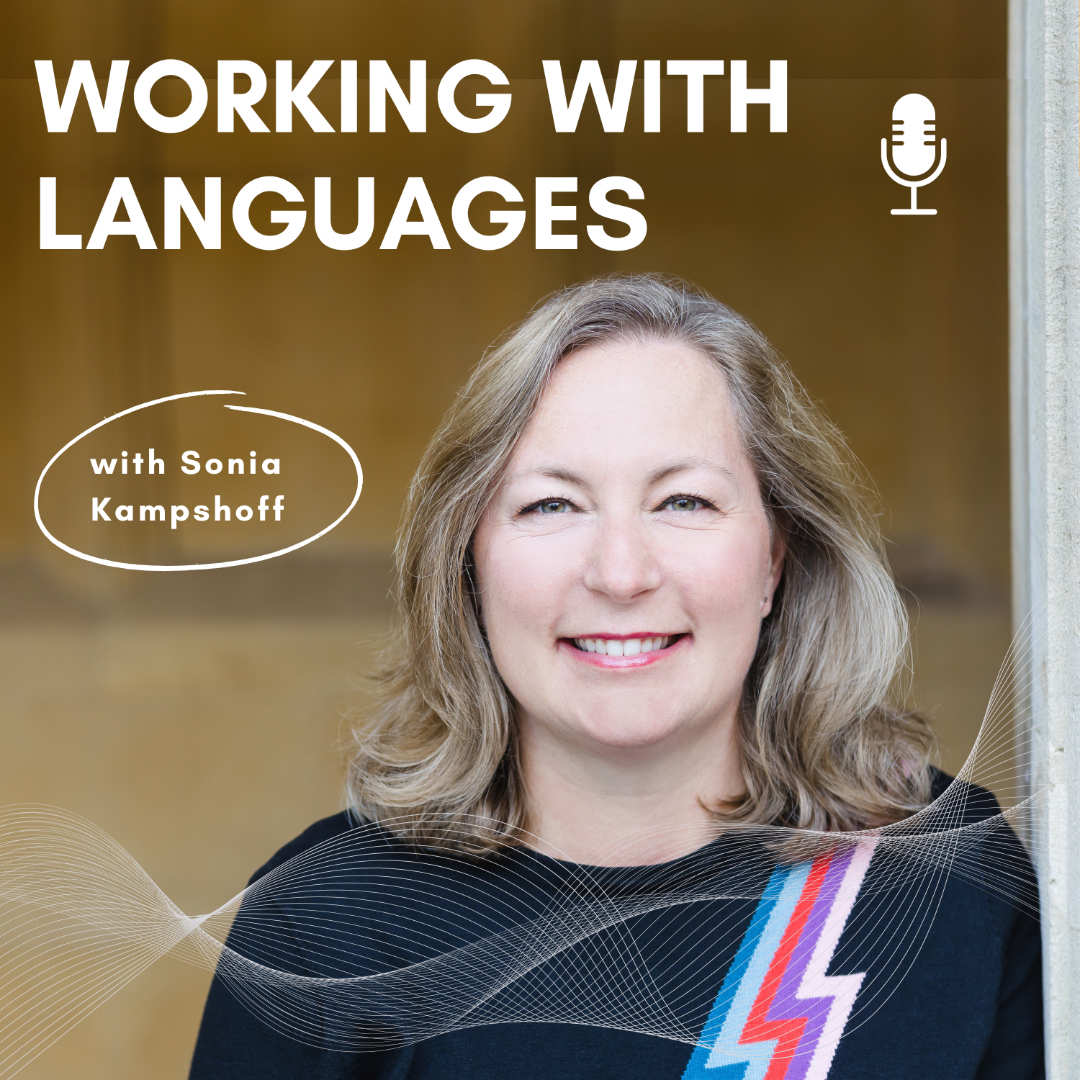
Sonia Kampshoff: Hello and welcome to working with Languages with me, Sonia Kampshoff. Together with my guests, we will explore what languages they speak and where they learn them. Their background and their career path, and they will also share their favorite word in a language they speak.
Welcome to this very first episode of the podcast and I’ll introduce myself. I’m Lucy Lucraft and I am a podcast producer and I am helping Sonia with her podcast. We thought it would be fun to do this very first episode as. Me interviewing Sonia so that we can learn about why you wanted to start the podcast, your background, why you are here.
First of all, hello, how are you?
Sonia Kampshoff: Hello, Lucy. I’m very excited we are here.
Lucy: So we’re gonna kick off with a fun question. What is your favorite word in a language that you speak?
Sonia Kampshoff: So I actually grew up speaking two languages. So I’ve decided to tell you about two words, one in each language. The first word is in German, and it’s berufstätig. It literally means someone who is active in the workforce, has a job, has a career, and the reason I like this word is that it’s, it’s very specific. In English for example, you say, do you work? And people say yes or no. If they’re out of work, maybe they’re looking after children or they’re on a sabbatical, they say, no, it don’t work. But actually, is that true? It refers only to the paid work that a person can do, whereas German has this very specific word that doesn’t limit the conversation to paid or unpaid work.
The other word is actually two words in Italian, and it is quanto basta, I love this word. There’s two words. They’re normally used in a culinary settings when cooking, and it means literally as much as is enough. So for example, you say, oh, this needs a little bit more salt or a little bit more pepper. And you say, how much so should I add? And you say quanto basta, as much as is enough. And to me it implies a deep knowledge and a deep skillset. And that is why I like that.
Lucy: I love them both. They’re great. So I would love to know how you learnt your languages.
Sonia Kampshoff: So I have, when people ask me where I’m from, I don’t have a short answer. I am half German, half Italian, as in my mother is German and my father is Italian, and I was born and raised in Italy, so all my childhood was in Italy, schooling, everything. And in Italy we have these famously, or infamously, long ho summer holidays, about three, three and a half months where children are out of school.
So what my mum did is she used to send us to Germany for six weeks and I spent all my summer holidays in Germany. With my grandmother, and this is, this went on for a few years until I was a teenager, and this is how I learned my two languages in, in an everyday setting in Italy, at school and in everyday life.
Lucy: That is such an interesting way to grow up. Yes. I feel like in England that we just don’t, that’s, that just doesn’t happen.It’s unusual. Even in Europe, there’s not many people who send the children away for six weeks during the summer, I presume. Then you were like, I’ve already got two languages.
Sonia Kampshoff: I speak them fluently. Three languages.
Lucy: What’s your educational background? What did you decide to do? So, I, I love languages. I always loved them. I loved speaking in different languages and how you can express different things so you can express yourself differently in different languages, and I always knew I wanted to work with languages.
The next best thing for me was being a translator, so I embarked in this bachelor degree. And I remember one of the jobs that I did was to help with interpreting for manufacturers of really large printing machines, for example, for books and magazines. And that was really interesting because it would allow me to travel to other parts of the country and be there while the machine was being set up and the local staff was being trained up.
So that was very interesting. I did my Erasmus University Exchange to Dublin, which was amazing. And then after graduating, I thought I would just go to London for a short projects, but I never left London or the UK. And initially when I came to London, I specialized in translating, it’s called localization, which means translating software, the words in a software, both word on a screen, and also any user manuals or any, when you make an error when you do something, you press something you’re not supposed to press and it gives you an error message.
All of these things. Some people find it a bit dry. I find it, I found it at the time, very interesting because it gave me an introduction in how it, it was a different way of looking at a software, how a software is built and everything that is behind it.
And also, once you put the translated language into the software, we would do, we would test it, we would run through all the processes. That people would use and find if there were any inconsistencies in the language, maybe a long word would go to the next line in the wrong way, or the wrong error message would be displayed or something was not very clear.
Once you put it into context, then you realize that the translation doesn’t make sense and you would need to change the translation. So all of that, it’s not, we didn’t test the functionality itself, but all the language that is behind it. I did that for a couple of years. And then I was made redundant.
And the next job I found was languages including marketing. And that is how I sort of transitioned from purely translating into marketing. And my first job was very interesting, was for an early days startup where I learned a lot of how, what technology can do and automation and all of that. It was at very fast paced and I worked, there were, it was a British company that wanted to expand into Germany and Italy.
And that was my first project of helping companies, established companies expand into different countries. And there I translated everything from all the, everything on the website, all the help pages, FAQ, but also the automated emails. I also translated, I helped translate the terms and conditions.
We had a lawyer revise everything because it was a legal document and I’m not specialized in that. But I did a whole, the whole package, I tested everything in the software and so on. And once we launched and expanded, I would also do all the marketing. From SEO, search engine optimization, also Google Advertising and PR.
Lucy: So I just wanna stop there because this is so interesting. So at this stage you are, yes you’re translating copy and doing what some people might think of as a very, the traditional, what you think of when you think of translating. Right. But when it comes to things like SEO and actually even just expanding into a different market, you are then taking on a whole different aspect of using your languages, right?
Sonia Kampshoff: Yes. Because you’re then starting to think about what. Would someone in Italy, what phrase would they use to search for something? And that’s not something you can translate really word for word as it is. That’s where you have to bring in the understanding of a different market. I think that’s very interesting.
Lucy: Could you talk a little bit more about that?
Sonia Kampshoff: Yes. As you say, it was a very interesting experience because it really helped me move into this new line of work and bring in all my language and also cultural expertise because as you say, when people Google something, when they put keywords, the words into Google, into the search bar, they don’t necessarily use the same words or phrases.
They don’t express themselves in the same way, and you as much as you can translate it, you should always be aware of the cultural nuances, the finesse that is behind the language, and how people actually speak, behave, search, and so on. It was a very interesting time. We, it was a very successful company and I learned a lot of things and, and that made me understand that actually I do like marketing and I would like to continue working more in marketing.
When I left, I, I went on to study a master in marketing at a European business school, and that gave me the, a, a wider knowledge of marketing as well as. Being it at business school, it was a commercially driven, so it gave me the commercial understanding of everything that lies behind it. And after my master, I decided that I wanted to specialize.
I wanted to specialize, pick an area of marketing that I wanted, that I liked and I wanted to specialize in. And I decided that this area would be what is called paid media, i.e. advertising on Google and on social media. At the beginning I worked mostly with advertising on Google. Later on I expanded to social media, and the reason I like this area is that it’s very much a mix of umbers and psychology.
There’s a lot of numbers. There’s a lot of KPIs. How many people see the ad? How, how many people click on the ad? Why? How much is the cost of every click and so on, and how much are you getting out of it? Be it a sale or a lead that you’re generating or sign up to a newsletter. So there’s a lot of numbers that you look at and understanding how to optimize everything is really interesting.
But at the same time, there’s a very vast understanding, a very vast part of psychology, understanding why people behave in a certain way online. Why do people search for certain words? Once they see your ad, why do they click on it? Why not? And once they click on it and land on your website, why do they do what they do?
Why do they take the action you want them to take? Or they do not. So I find it a very interesting mix of numbers and psychology. And there’s other areas of marketing that I also find quite interesting. For example, SEO. In a way goes hand in hand with advertising on Google and social media. nd I do work even today quite closely with teams who do social SEO. But I specialize even now in in paid media.
And after my master, I worked for different companies, mostly in-house, working for the company directly. I worked for, first for a training provider, and then I moved on to technology companies, for example, Lynda.com, which was then acquired by LinkedIn, and I was there during the acquisition.
I also worked for ShopStyle. I like working with technology companies because they, there’s the technology that they have behind them allows for a lot of test and learn you, which is something that I like this. Fast, uh, moving environment. In digital marketing, there’s always something changing, something new.
It doesn’t allow you to rest on your laurels, but you have to continue learning and at the same time, you want to understand, you want to test with this change, make a difference to how the advertising perform. And I do. This is very much how I like to work. In a test and learn environment, trying out new things and making sure that you optimize whatever you’re doing in a very efficient way.
Lucy: When did the move to self-employment come? So after working a number of years for companies directly, I worked, I then moved to an agent agency side. I worked for an agency for two years, and in the middle of COVID and everything, I realized I actually wanted to do something myself. And at the end of 2020, I decided to become self-employed and I set up my own company more perfect digital.
And since then, I’ve been working directly with my own clients. I have clients in various industries and I have, I, I generally have long ongoing relationships with them whereby I run their advertising on Google and social media. I work on strategy and I work on operations, optimization, reporting and all of that, and it’s, I do enjoy, in a way being part of the team, but on a self-employed basis. I work both with companies that sell things online on the, what is called e-commerce, but also companies that pay me to and run advertising to generate leads so they can sell, for example, software or services and so on.
The other type of project that I do occasionally and I enjoy very much I would like to do more of this actually, is again, helping established companies expand into Germany and Italy. And I, as I mentioned previously, I’ve done it before, I’ve done it for other companies in my career and it’s something that I’m very, I think I’m very good at because I have the cultural and the language expertise, but I also understand technology and.
I understand the differences online for websites and the presence online, how people, how companies present themselves in different ways in the UK, in Germany, in Italy, and so on.
Lucy: You’ve talked about the clients and the companies you work with, but who, I wanna know less about who you currently work with and maybe who are your sort of dreamy clients that you just, that you, you bring your specific skillset to.
Sonia Kampshoff: Yeah, so my ideal client is technology companies or companies that are comfortable with technology and work with technology. Medium sized or large companies. And they are they companies that also have a sort of test and learn approach and companies who are willing to listen and to do look at the hard numbers to make decisions.
As I mentioned, I work both in e-commerce and lead generation. I like both business models, but it’s more about companies having a product or service that is useful and working in a modern technology friendly way.
Lucy: And speaking of technology, obviously there’s lots of fear-mongering around ai. I know that you have a tech head, so I would love to know how you use it. How do you use technology and AI in your work, but also in your personal life?
Sonia Kampshoff: I use it a lot. I think I started using AI before it became known as ai and how you can do with it all the smart bidding and the optimizations that are available there. Google and Meta and all the others, LinkedIn all introduced all these smart features in their advertising.
So I’ve been using that for a long time before they became known as classic AI and nowadays when I need to translate something, for example, maybe social media captions or something like that, I always start by translating with Google Translate or other AI softwares that makes translation really fast and simple.
I never take it one-on-one. I always review it and I change a few things. There’s always the, some words that Google Translate is still not very good at. And phrasings, maybe the tone of voice need needs to be optimized for that specific client or formal and informal. Google Translate sometimes. Gets confused about formal and lymphoma. So I start with an AI translation and then I review it. But overall, the process is much, much faster.
Lucy: Alright. Let’s move on a little bit. To your knowledge specifically, what trends do you see in your specific industries? So marketing. Yeah. What sort of trends are you seeing?
Sonia Kampshoff: I think the general trend is definitely AI expanding into various areas. And I think Google Meta, LinkedIn and so on, they all realize that some people get a bit scared about AI stealing jobs and so on. So what I find is that they use more and more ai, but generally they, they don’t call it that. They use it, they use different wordings to describe it from smart bidding.
Smart technology, different specific campaign types that Google has introduced in the last couple of years, but generally speaking, definitely the trend is on AI. Yeah. And I find that AI is useful, but at the same time, once you work on with a company or on a specific account, you develop the knowledge of the company and of the products or services that you’re selling.
It’s always important to have someone. Knowledge of product services or languages that reviews everything. I would never want to leave everything to smart bidding and auto to apply and all of that.
Lucy: What is smart bidding?
Sonia Kampshoff: Smart bidding. A good question, smart bidding is when you say you run advertising and you say you want to optimize, for example, for people coming on the website and visiting the website, or you can say, I want to optimize for people buying a certain product, or you want to optimize for people giving you contact details and becoming a lead. So there’s different objectives, okay. That you can use when you run advertising.
And smart bidding simply allows you to say, Google, go and do your work. I want this objective, okay. For my campaign, and this is the money that I want to spend. So it’s like a prioritization.
Previously you would decide how much you wanted to spend for a click. So for example, one pound or 50 pounds. Or two pounds. Whereas now you leave all of that to Google. Or Meta. And they decide how much to spend for every click, but with the ultimate objective of giving you either traffic or sales or leads or whatever else you’ve decided.
Lucy: Fine. Okay, thank you. Okay, so this is quite a broad question. What tips would you give to people that wanna get into digital marketing?
Sonia Kampshoff: And I think, first, I would love for you to give a sort of an explanation of what digital marketing is because I think we often forget how broad it is.
So digital marketing is a very broad discipline. And it’s, I like to remind people it’s digital as opposed to, for example, brochures that are printed or offline events, all of that. Nowadays there’s, there’s what I do the, all the advertising on Google and social media, there’s search engine optimization, which essentially allows companies, when someone types something into Google, the website of the company comes up high in the search results, but that is not paid , that is all organic.
There’s also social media. There’s influencers, affiliate marketing, which you know, I refer using referral codes and referral link. There’s various parts of digital marketing and there’s some people who specialize on it in one. So there’s other people who are more generalists and have a broader range of the work that.
People also specialize in different industries, being e-commerce, lead generation, but also very often specific sectors in each industry. I find that people who enjoy and are good at digital marketing are people who comfortable with technology and, uh, happy to learn. Are continuous learners because in digital marketing, being curious is very good.
It, it allows you to ask yourself questions, how can I do this better in an environment, in an industry that is ever changing? So people who like, people like me, I like Excel, but I also like psychology. They’re very, all the paid media is very good. There’s other people who like writing, copywriters and they could go down the SEO route. People who enjoy spending time on social media could do more of the social media and influencer side.
So there’s, it’s a, there’s low barriers to entry, so you don’t necessarily need a degree to start working in marketing, digital marketing, and you can really follow what you like doing. And also the specific industries.
The one thing I would say is that different industries and different types of work can pay differently. Hmm. So if you want to decide which area to specialize in, for example, or which sector to specialize in, go and have a look at all the salaries and how many jobs are available, salaries at different levels, manager, director, and so on. And that can help you decide which route to go down to, because salaries can be very different even within digital marketing. Yeah.
Lucy: So broad, isn’t it? What it, what does pay the best?
Sonia Kampshoff: Generally speaking? Corporate work pays very well. Yeah, and there’s. The more classic industry health, um, insurance and so on tend to pay. The other one that can be very interesting for people is startups. Startups very often pay normal salaries at the beginning, but there is a lot of, um, very often equity involved. So if the startup becomes, um, profitable and grows a lot than you own part of the company, but that is a choice because it’s a potential remuneration that comes later on. And it may work, it may not. Yeah. So that is a choice.
Lucy: That’s really interesting. And focusing specifically on languages, what do you find are the most requested languages? Obviously your languages are German, Italian. English, German and Italian, but are there others that are requested?
Sonia Kampshoff: Yes. My working language is English, so I work with some clients, I work in English only. I don’t do all of my work with languages, and that is fine. I find that having a working language with English also allows me to be close whenever something new comes out with Google better and LinkedIn, because then the release normally is in English and only the, then it’s translated into different languages.
That gives me a little bit of an advantage. I mostly work with European languages. I do some work with French as well, so my knowledge is generally around European languages. I know less about Asian languages, for example. I find that the work that I get for German is very different than the work that I get for Italian and generally speaking, I also get more work with German and I think, I can’t give you an answer that is set in stone, but I think it’s down to the economy.
It’s a very, Italy and Germany have a very different economy, different industries, different just different cultures. Yeah, really. And it just so happens that I work more with Germany and German.
Lucy: Okay. So final question. Why the podcast? Why did you decide to start this podcast?
Sonia Kampshoff: I grew up surrounded by languages and different cultures, and I even now, I live in the UK. My husband is German. Our daughter goes to the German School in London. I’m surrounded by languages and intercultural elements to life, and what I often find is that people from any countries learn languages, even to a very good level, but then often go into work and they don’t use their languages. And I think it’s, it’s a missed opportunity.
And what I would like to do with this podcast is tell stories of people who use languages in their work, in their day-to-day work. Being a translator or, or even the work that I do, marketing plus languages. There’s so many ways of integrating languages in, you know different industries, whether you’re self-employed or employed, small companies, large companies, or international organizations. There’s just so many ways of using languages in the work that you do. And I would like to, I would like to show people everything that can be done working with languages.
Lucy: What can people expect from the podcast?
Sonia Kampshoff: I’m going to be be speaking with guests. I want to have conversations similar to this one, but next time I’ll be on the host side. And I will be talking to individual guests one by one, and I will ask them where they come from, which languages they speak, and how they use wet languages at work.
Some of the guests that I, uh, I have lined up are translators, for example, for TV and film subtitles, but also people in coaching and people working for large international organization who work in English, but there’s so many cultures they need to use languages and culture, cultural awareness in their day-to-day work.
Lucy: That’s super exciting. And so before the podcast drops, where can everybody find you online and learn more about your work and what you do?
Sonia Kampshoff: The best place to find me is on LinkedIn under Sonia Kampshoff, and also on my website More Perfect Digital. And I look forward to hearing from you both for work and also if you have any questions that you have about the podcast or any guests that you would like to suggest or any any questions that you have for my guests.
Lucy: Perfect. Thank you for letting me host.
Sonia Kampshoff: Thank you very much for your help, Lucy.
Thank you for listening to this week’s episode. If you liked it, please subscribe and share it with someone who may enjoy it too. As a new podcast, we value your feedback, so please leave us a comment or email us at the email in the show notes.